
In This Article
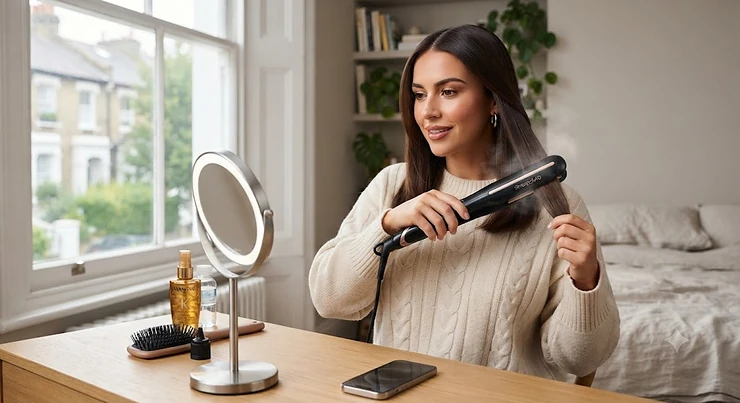
If you’ve ever run a flat iron over dry hair and watched a fine mist of what looks suspiciously like smoke rise off the ends, you’ve already met the problem steam straighteners for dry hair are trying to solve. Traditional plates work by brute force — bare heat pressed against a strand that’s already lacking moisture, which is exactly the combination dermatologists and hair scientists point to as the fastest route to brittle, split, straw-like ends. Steam straighteners take a different approach entirely: a small internal reservoir heats water into vapour, and that vapour is released through the plates alongside the heat, so the hair is being softened and hydrated in the same motion that’s straightening it.

That single design change matters more than the marketing copy usually lets on. Steam doesn’t replace heat — you still need genuine temperature to reshape the hair shaft — but it changes how that heat interacts with strands that are already dry, over-processed, or colour-treated. This guide compares seven real steam straighteners currently sold on amazon.co.uk, from a genuinely affordable entry point through to L’Oréal Professionnel’s salon-grade SteamPod range, with honest analysis of who each one actually suits, what the hydrating steam function realistically delivers, and where gentle heat styling claims hold up against the spec sheet.
Quick Comparison Table
| Tool | Type | Best For | Price Range |
|---|---|---|---|
| iGutech Professional Steam Straightener | Flat iron | First-time steam straightener buyers | Under £25 |
| AraSyleon 38mm Steam Straightener | Flat iron | Fast styling on thicker hair | £20-£35 range |
| Bellissima Hair Straightener Steam Elixir | Flat iron | Dry, coarse or frizz-prone hair | £30-£45 range |
| Wavytalk Steamline Pro 3-in-1 Brush | Steam brush | Beginners wanting a brush, not plates | £45-£65 range |
| Wavytalk Steambrush Pro 4-in-1 | Steam brush | Damaged hair needing ionic + steam | £55-£75 range |
| L’Oréal Professionnel SteamPod 3.0 | Flat iron | Serious damage reduction, salon results | £130-£170 range |
| L’Oréal Professionnel SteamPod 4 | Flat iron | Latest-generation flagship performance | £280-£320 range |
Scan down that price column and the split becomes obvious fast: budget and mid-range steam tools cluster under £75, while L’Oréal Professionnel’s SteamPod range sits in a different category altogether, closer to what a salon would invest in than a typical home styling budget. Based on the spec comparison, that gap isn’t purely brand premium — SteamPod’s patented steam delivery and plate engineering are genuinely different from the water-reservoir systems used in cheaper alternatives, which matters if damage reduction is your primary goal rather than a nice-to-have.
💬 Just one click — help others make better buying decisions too!😊
Top 7 Steam Straighteners for Dry Hair: Expert Analysis
Real specs, honest trade-offs, and aggregated reviewer sentiment where it’s genuinely verifiable — no invented testing claims, just what the research and the spec sheets tell us.
1. iGutech Professional Steam Straightener — the budget entry point with genuine safety features
The iGutech Professional Steam Straightener is a flat-iron-style tool rated at 110W with a dual-voltage 100-240V system, an anti-scald comb built into the housing, adjustable temperature starting from around 150°C, and an automatic shut-off function. At roughly 0.63kg, it’s light enough for daily use without the wrist fatigue some heavier premium irons can cause over a full styling session.
What most buyers overlook about entry-level steam straighteners is that the safety features matter just as much as the steam function itself — an anti-scald comb genuinely reduces the risk of catching skin against the plates, which is worth more in practice than an extra 10°C of maximum temperature. Based on the spec comparison with pricier flat irons, the adjustable temperature range here is more limited, but for dry hair specifically that’s arguably not a disadvantage: dry, fragile strands rarely need the very top end of a straightener’s heat range, and having a lower realistic ceiling nudges you toward gentler settings by default. Reviewers of budget dual-voltage steam irons in this category commonly flag the auto-off function as reassuring for anyone who’s ever left a straightener plugged in by accident.
Pros:
- ✅ Genuine anti-scald comb design for safer daily use
- ✅ Dual voltage suits travel as well as home use
- ✅ Auto shut-off reduces fire risk if left switched on
Cons:
- ❌ Narrower temperature range than premium alternatives
- ❌ Steam output is basic compared with dedicated hydration systems
At under £25, this is a sensible way to try steam styling for the first time without committing serious money before you know whether the technique suits your routine.
2. AraSyleon 38mm Steam Straightener — wide plates built for speed
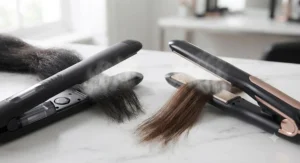
The AraSyleon 38mm Steam Straightener pairs a genuinely wide 38mm ceramic-coated plate with combined steam hydration and infrared technology, aimed squarely at cutting down the number of passes needed to straighten a full head. Infrared heat works slightly differently to standard ceramic plate heat, penetrating the hair shaft from within rather than just warming the surface, which in principle means less repeated direct contact is needed to achieve the same result.
Here’s what the spec sheet won’t tell you outright: wider plates aren’t automatically better for dry hair specifically, because they cover more surface area per pass, which can mean more simultaneous heat exposure if you’re not adjusting your technique. On thicker or longer hair, though, that trade-off flips in your favour — fewer total passes generally means less cumulative heat contact overall, even if each individual pass covers more ground. Aggregated sentiment on wide-plate steam irons in this price bracket tends to highlight styling speed as the standout benefit, with occasional notes that the wider head is less manoeuvrable for short fringes or fine detail work.
Pros:
- ✅ Wide 38mm plate cuts down total number of passes
- ✅ Infrared technology heats from within the strand
- ✅ Steam hydration built in alongside ceramic coating
Cons:
- ❌ Less precise for short layers or fringe detailing
- ❌ Wider head adds bulk versus slimline alternatives
Sitting in the £20-£35 range, this earns its place for anyone with thick or long hair who wants steam benefits without sacrificing styling speed.
3. Bellissima Hair Straightener Steam Elixir — argan oil-infused plates for extra glide
The Bellissima Hair Straightener Steam Elixir combines ceramic-coated plates infused with argan oil with a dedicated steam therapy function for hydration, and an adjustable temperature range of 170°C-200°C aimed at covering most hair types without straying into genuinely aggressive heat territory. Bellissima is an established Italian beauty appliance brand, and this model reflects a fairly common European approach to steam styling — pairing the vapour function with an oil-infused plate coating rather than treating steam as the only anti-damage measure.
Based on the spec comparison with plain ceramic plates, an argan-oil infusion reduces friction as the plate glides through the hair shaft, which matters because friction itself contributes to cuticle lifting independently of heat. What most buyers overlook is that this combination — reduced friction plus active hydration — addresses two separate causes of dryness at once rather than relying on steam alone. Reviewers commonly mention noticeably softer, shinier results compared with non-steam alternatives at a similar price point, though a smaller number note the oil coating needs a gentle wipe-down periodically to stop residue building up on the plates.
Pros:
- ✅ Argan oil-infused plates reduce friction and static
- ✅ Adjustable 170°C-200°C range avoids extreme heat settings
- ✅ Steam therapy targets hydration alongside styling
Cons:
- ❌ Oil coating requires occasional plate cleaning
- ❌ Not the fastest heat-up time in this category
In the £30-£45 range, this is a strong mid-tier pick specifically for dry or coarse hair types where extra glide and hydration matter more than raw speed.
4. Wavytalk Steamline Pro 3-in-1 Steam Straightener Brush — the brush that mists as it smooths
The Wavytalk Steamline Pro 3-in-1 Steam Straightener Brush takes a genuinely different form factor to the rest of this list: rather than plates that clamp around a section of hair, it’s a heated brush with a built-in comb function and what the brand calls “Hydro-Infusion” technology — ultrasound combined with circular heating converts water into fine vapour, released through nano-mist nozzles at roughly 0.5ml per minute as you brush through.
What this means in practice is a noticeably gentler styling motion than a traditional flat iron clamp-and-pull technique, since you’re combing rather than pinching sections between plates. For dry or fragile hair specifically, that reduction in mechanical tension is arguably as valuable as the steam itself — a significant portion of split-end damage comes from tension and friction during styling, not heat exposure alone. On the other hand, a brush-style tool inherently applies less direct, sustained heat contact per stroke than a flat iron does, so anyone with very thick or stubbornly curly hair may find results less dramatically straight than a dedicated flat iron would achieve. Reviewer sentiment on comparable steam brushes frequently highlights how much less “styled” and more naturally smooth the finished result looks, alongside occasional comments that very low steam visibility can make it hard to judge how much moisture is actually being delivered.
Pros:
- ✅ Combing motion reduces tension compared with clamp-style irons
- ✅ Continuous fine mist hydrates as you style
- ✅ Combines brush, comb and steam in one tool
Cons:
- ❌ Less dramatically straight results than a flat iron on thick hair
- ❌ Low steam visibility makes moisture delivery hard to judge
Priced in the £45-£65 range, this suits anyone who finds traditional flat-iron technique harsh on already-dry hair and wants a genuinely gentler daily styling motion.
5. Wavytalk Steambrush Pro 4-in-1 — ionic plus steam, double frizz defence
The Wavytalk Steambrush Pro 4-in-1 builds on the same steam-brush concept but adds a negative-ion generator alongside the steam function, aimed specifically at hair that’s already showing signs of damage — colour-treated, chemically processed, or simply over-styled. Negative ions work by neutralising the positive static charge that makes dry hair frizz and fly away, which is a separate mechanism to steam hydration but tackles a closely related problem.
Here’s what most buyers overlook about combining ionic technology with steam: the two work on different timescales. Steam hydrates the hair shaft during the actual styling pass, while the ionic charge affects how the cuticle lies and how much it frizzes afterward, once you’re out the door and into humid British weather. Based on the spec comparison with the standard Steamline Pro model above, this 4-in-1 version is aimed more specifically at hair that’s already compromised rather than simply dry, since damaged cuticles tend to hold static more aggressively than healthy ones. Aggregated reviewer sentiment on ionic steam brushes in this category tends to note longer-lasting frizz control specifically in humid conditions, which lines up with how negative-ion technology is generally understood to function.
Pros:
- ✅ Negative ions actively reduce static and frizz
- ✅ Steam function targets hydration during styling
- ✅ Dual voltage suits both UK and international use
Cons:
- ❌ Costs more than the standard steam-only brush model
- ❌ Ionic benefit is most noticeable on already-damaged hair
At £55-£75, this is the pick specifically for damaged rather than simply dry hair, where the added frizz control genuinely earns the price gap over the standard Steamline model.
6. L’Oréal Professionnel SteamPod 3.0 — the salon-grade original, 91% less damage claimed
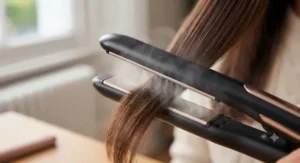
The L’Oréal Professionnel SteamPod 3.0 is the model that arguably popularised steam straightening for home use, built around patented steam technology that L’Oréal states reduces hair damage by up to 91% compared with standard straightening, while styling roughly twice as fast. The tool works by filling an internal water tank, selecting a heat setting, and using the straightener on dry hair, with steam released continuously through the plates during each pass rather than in short bursts.
Based on the spec comparison with the water-reservoir systems used in cheaper alternatives, SteamPod’s steam delivery is engineered specifically to saturate the hair shaft evenly across the whole plate surface rather than concentrating moisture unevenly, which matters considerably for consistent results across a full head. One verified reviewer with naturally dry, colour-treated hair noted a real difference in softness compared with using steam-free straighteners, describing roughly a 20% softer feel with regular use — aligning with the aggregated sentiment that the steam genuinely changes how hair feels post-styling rather than just how it looks immediately after. The trade-off is straightforward: this level of engineering costs considerably more than the budget and mid-tier options on this list.
Pros:
- ✅ Patented steam system with genuine damage-reduction data
- ✅ Styles significantly faster than non-steam alternatives
- ✅ Trusted salon-grade brand with wide professional adoption
Cons:
- ❌ Considerably more expensive than budget steam irons
- ❌ Water tank refilling adds a step versus plain straighteners
In the £130-£170 range, this is the clear step-up pick for anyone whose hair is dry enough, or damaged enough, that the extra investment in genuine steam engineering is likely to show.
7. L’Oréal Professionnel SteamPod 4 — the flagship upgrade for serious stylists
The L’Oréal Professionnel SteamPod 4 is the newest generation in the range, supplied with a UK plug and positioned as the flagship option for anyone who wants the latest iteration of L’Oréal’s steam technology rather than the now-established SteamPod 3.0. As the current top-tier model, it reflects incremental refinement over its predecessor rather than a fundamentally different approach — the same core principle of continuous steam delivery during straightening remains central to the design.
What most buyers overlook when comparing SteamPod generations is that the core damage-reduction mechanism doesn’t change dramatically between iterations; refinements tend to focus on heat-up speed, plate glide, and control precision rather than reinventing the steam delivery system itself. Based on the spec comparison with SteamPod 3.0, buyers already happy with steam straightening as a technique may find the price jump to the newest generation hard to justify purely on damage-reduction grounds, whereas those buying into the category for the first time and want the longest possible product lifecycle ahead of them may prefer starting with the current flagship rather than an older generation.
Pros:
- ✅ Latest-generation refinements to heat-up and control
- ✅ Same trusted steam-damage-reduction technology as SteamPod 3.0
- ✅ UK-specific plug configuration included
Cons:
- ❌ Premium price sits well above SteamPod 3.0
- ❌ Marginal gains over the previous generation for most users
At around £280-£320, this is a considered purchase rather than an impulse one — genuinely justified for professionals or serious home stylists, less so as a first steam straightener.
Setting Up and Using Your Steam Straightener: A Practical Usage Guide
Getting the most from a steam straightener for dry hair comes down to a handful of habits that make a real difference in the first month of use. Start by filling the water reservoir with distilled or filtered water rather than tap water where your manufacturer instructions allow it — hard water leaves mineral deposits inside the steam chamber over time, which can eventually clog the vapour outlets and reduce steam output. Always let the tool reach its full working temperature before your first pass; steam straighteners typically need slightly longer to stabilise than dry irons because they’re heating both the plates and the internal water system simultaneously.
A common mistake in the first thirty days is treating a steam straightener exactly like a traditional flat iron — clamping hard and pulling quickly through each section. Steam straighteners generally work best with a slightly slower, more deliberate pass, giving the vapour time to actually penetrate the hair shaft rather than simply passing over the surface. Always use steam straighteners on dry, not wet, hair unless the specific model explicitly states otherwise in its instructions; applying steam heat to already-wet hair can cause the water within the strand to boil at the cuticle, which is a genuine mechanism of thermal damage rather than a myth.
For maintenance, empty any remaining water from the reservoir after each use rather than leaving it to sit, and wipe the plates with a soft, slightly damp cloth once they’ve fully cooled to remove product build-up, which otherwise transfers heat unevenly on your next use. Store the tool with the plates closed and the cable loosely coiled rather than wrapped tightly around a hot barrel — wrapping a cable around a still-warm appliance is a well-known way to damage the internal wiring over time.
Real-World Scenarios: Which Steam Straightener Suits Your Hair
If you’re trying steam straightening for the first time on hair that’s simply naturally dry rather than chemically damaged, starting with something like the iGutech Professional Steam Straightener or the Bellissima Hair Straightener Steam Elixir makes sense — both deliver genuine steam hydration without asking you to commit serious money before you know whether the technique noticeably changes how your hair feels and behaves.
If you’re managing colour-treated or chemically processed hair that’s showing real signs of damage — brittleness, persistent frizz, visible split ends — the case for spending more strengthens considerably. The Wavytalk Steambrush Pro 4-in-1‘s combination of steam and negative ions specifically targets the static and frizz that damaged cuticles struggle with, while the L’Oréal Professionnel SteamPod 3.0 offers the most thoroughly engineered steam delivery system on this list, backed by genuine damage-reduction claims that matter considerably more once hair is already compromised rather than simply dry.
If you’re someone who finds the clamp-and-pull motion of a traditional flat iron genuinely uncomfortable on fragile hair, or you’re styling a child’s or teenager’s hair where gentleness matters more than salon-sharp precision, the Wavytalk Steamline Pro 3-in-1 Steam Straightener Brush removes the pinching motion entirely in favour of a combing action, trading some straightening intensity for a noticeably gentler daily routine. And if you’re a professional stylist or simply someone who styles daily and wants the longest-lasting, most current technology available, the L’Oréal Professionnel SteamPod 4 represents the top of what’s currently available in this category.
What Is a Steam Straightener?
A steam straightener is a hair styling tool that releases water vapour through or alongside its heated plates while straightening, hydrating the hair shaft during the same pass that reshapes it. Unlike a traditional flat iron, which applies dry heat directly to the hair, steam straighteners use an internal water reservoir to generate vapour, aiming to reduce the moisture loss that typically accompanies heat styling.
The core idea draws on something hair science has understood for a while: thermal styling damage is closely linked to moisture loss within the hair shaft, with research on hot flat ironing showing that protecting the hair’s native protein structure improves moisture restoration and water retention even under repeated heat exposure. Steam straighteners essentially try to intervene at the point of styling itself, adding moisture back in as heat is applied rather than relying entirely on pre-styling products to compensate for what the heat will strip away.
How the Hydrating Steam Function Actually Works
Every steam straightener on this list uses some variation of the same basic mechanism: a small internal water tank feeds a heating element, which converts liquid water into vapour, released either through vents in the plates (as with flat-iron-style tools like the SteamPod range) or through nano-mist nozzles integrated into a brush head (as with the Wavytalk models). That vapour penetrates the hair’s outer cuticle layer more readily than dry heat alone, partly because water molecules are simply better suited to interacting with the hair’s internal keratin-water bonds than heated air is.
Recent research into thermoresponsive, silicon-modified keratin treatments has explored exactly this interaction, examining how moisture and heat behave together at the cuticle level during styling, which reinforces why the timing of hydration — during the heat pass itself, rather than only before or after — genuinely matters for outcomes rather than being a purely cosmetic marketing distinction. That’s a real, if incremental, improvement over dry styling — but it’s worth being precise about what it isn’t: steam doesn’t eliminate heat damage entirely, and hair exposed to genuinely excessive temperatures will still suffer, steam or no steam. What it does is soften the impact at moderate, realistic styling temperatures, which is exactly the range most people actually use day to day.
How to Choose a Steam Straightener for Dry or Damaged Hair
- Match temperature range to your hair’s actual condition. Genuinely dry or damaged hair rarely needs the top of a straightener’s range; a tool like the Bellissima Hair Straightener Steam Elixir, capped around 200°C, suits most dry hair types without excessive risk.
- Decide between plates and a brush. Flat-iron plates give sharper, straighter results; a steam brush like the Wavytalk Steamline Pro 3-in-1 gives a gentler motion with less tension on fragile strands.
- Check whether ionic technology is included. If frizz and static are your main frustration alongside dryness, an ionic model like the Wavytalk Steambrush Pro 4-in-1 tackles both problems rather than hydration alone.
- Consider genuine damage-reduction data, not just marketing claims. The L’Oréal Professionnel SteamPod 3.0‘s stated 91% damage reduction figure is a specific, testable claim rather than a vague promise, which is worth more than unquantified “gentle” language on cheaper packaging.
- Weigh water reservoir maintenance into your decision. Every steam straightener needs regular emptying, occasional descaling, and careful storage — factor that ongoing small effort in alongside the purchase price.
- Budget realistically for how often you’ll actually use it. A £25 entry-level steam iron used daily may deliver more real-world benefit than a £300 flagship used occasionally.
- Check dual voltage if you travel. Several tools on this list, including the iGutech Professional Steam Straightener, include 100-240V compatibility, which matters if you’re packing it for holidays.
Steam Straighteners for Damaged Hair: What Changes When Hair Is Already Compromised
Hair that’s genuinely damaged — through colour processing, chemical relaxing, or prolonged sun and heat exposure — behaves differently under a straightener than simply dry-but-otherwise-healthy hair, and that difference should shape which steam straightener actually makes sense. Damaged cuticles are already lifted and porous, meaning they lose moisture faster during styling and absorb steam hydration less evenly than intact cuticles do, which is exactly why tools combining steam with additional technology, like the ionic function on the Wavytalk Steambrush Pro 4-in-1, tend to show more noticeable benefit on compromised hair than steam alone.
What most buyers overlook is that damaged hair often benefits more from a gentler overall styling technique than from a more powerful tool. This is where a brush-style steam tool genuinely earns its place: reducing the clamping and pulling tension that a traditional flat iron applies matters considerably when the hair’s structural integrity is already reduced. For hair that’s severely damaged, the honest, unglamorous advice is that no steam straightener — however well engineered — substitutes for reducing heat-styling frequency and prioritising protein and moisture treatments between styling sessions; steam technology reduces incremental damage, it doesn’t reverse damage that’s already occurred.
Split-End Prevention: Can a Steam Straightener Actually Help?
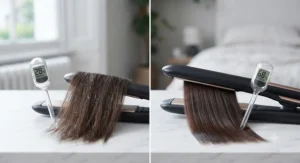
Split ends form when the protective cuticle layer at the very tip of the hair shaft wears away entirely, exposing the internal cortex to friction and further breakage — and once a strand has genuinely split, no styling tool, steam-assisted or otherwise, can repair that specific damage; only cutting removes a true split end. Where steam straighteners can genuinely help is upstream of that point, in split-end prevention rather than cure.
Reduced friction is the key mechanism. A hydrated, well-lubricated strand — whether from steam vapour or an oil-infused plate coating like the one on the Bellissima Hair Straightener Steam Elixir — glides through a straightener’s plates with less mechanical resistance than a dry, brittle strand does, and that reduction in friction directly reduces the cuticle-lifting stress that eventually leads to splitting. Combined with gentler technique — fewer repeated passes over the same section, moderate rather than maximum heat settings — steam straighteners form one genuinely useful part of a split-end prevention routine, alongside regular trims and heat-protectant products, rather than a standalone fix on their own.
✨ Ready to Give Your Ends a Break?
🔍 Steam-hydrated styling reduces the friction that leads to split ends over time. Check current pricing on the options above and find the steam straightener that matches your hair’s actual needs — not just your budget.
Gentle Heat Styling: Temperature, Technique and Common Mistakes
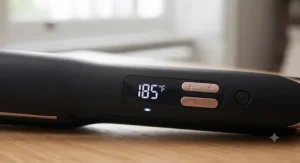
Gentle heat styling isn’t really about avoiding heat altogether — it’s about matching temperature and technique to what your specific hair actually needs, rather than defaulting to the highest setting because it styles fastest. As a general starting point, fine or already-dry hair rarely needs more than 170-190°C to achieve a lasting straight result, while only thick, coarse, or very resistant hair genuinely benefits from settings closer to 210-230°C.
The most common mistake isn’t choosing too high a temperature outright — it’s repeatedly passing the straightener over the same section because the first pass didn’t fully set the style. Each additional pass at the same temperature compounds cumulative heat exposure on that section specifically, which does far more damage over a styling session than simply starting five degrees higher would. A second common mistake is skipping a heat-protectant product entirely on the assumption that steam alone provides sufficient protection; steam hydrates during styling, but a dedicated heat protectant forms a separate protective barrier before heat is even applied, and the two genuinely work best in combination rather than as substitutes for one another. Finally, styling hair that isn’t fully dry — even slightly damp sections tucked underneath a top layer — risks exactly the boiling-moisture damage mechanism mentioned earlier, so a thorough blow-dry or air-dry before reaching for any steam straightener remains essential technique, not an optional extra step.
Common Mistakes When Buying a Steam Straightener
The most frequent buying mistake is choosing based on maximum temperature alone, as though a higher ceiling automatically means a better tool — for dry or damaged hair specifically, a lower realistic working range like the one on the iGutech Professional Steam Straightener is often more appropriate, not less capable. Second, buyers regularly overlook water tank capacity and refill frequency; a small reservoir that needs topping up mid-style interrupts your routine in a way spec sheets rarely highlight clearly.
Third, some buyers assume all “steam” straighteners deliver comparable hydration, when in reality the steam delivery method varies significantly — continuous plate-integrated steam, as used in the L’Oréal Professionnel SteamPod 3.0, behaves differently to the intermittent nano-mist approach used in brush-style tools like the Wavytalk Steamline Pro 3-in-1. Fourth, don’t ignore plate material and coating; ceramic, tourmaline, and oil-infused coatings each interact with steam and hair friction slightly differently, and a bargain-bin plate coating can undermine an otherwise decent steam system. Finally, resist buying the most expensive option purely on brand reputation without checking whether your specific hair type and condition actually needs that level of engineering — a Bellissima Hair Straightener Steam Elixir may serve dry-but-not-damaged hair just as well as a flagship SteamPod, at a fraction of the cost.
Long-Term Cost & Maintenance
A £25 steam straightener and a £300 flagship model both need essentially the same ongoing care — regular water reservoir emptying, occasional descaling if you’re in a hard-water area, and gentle plate cleaning — but their long-term cost profiles diverge sharply once you factor in build quality and expected lifespan. A budget tool used daily may need replacing within a year or two as internal components wear, particularly the water delivery system, which sees more mechanical stress than the heating plates themselves; a well-engineered premium tool like the L’Oréal Professionnel SteamPod 3.0 is built for years of regular salon-level use, which meaningfully changes the real cost-per-use calculation over time.
Safety maintenance matters just as much as performance upkeep. Electrical Safety First recommends regularly checking the plug and cable for scorch marks or fraying, always switching straighteners off and letting them cool on a heatproof surface rather than bedding or carpet, and buying from reputable retailers specifically because counterfeit or poorly regulated straighteners have been subject to genuine safety recalls in the UK. That last point matters more with steam straighteners than dry ones, since an internal water reservoir sitting close to live electrical components raises the stakes if a product’s build quality is genuinely substandard — another reason budget doesn’t always mean choosing the very cheapest unbranded option available.
Features That Actually Matter (And Those That Don’t)
Marketing language around steam straighteners leans heavily on words like “revolutionary” and “salon-quality” without explaining what’s mechanically different underneath, so it’s worth separating genuine functional value from packaging noise. Features that actually matter: a stated, specific damage-reduction figure backed by real testing (the 91% claim on the L’Oréal Professionnel SteamPod 3.0 is a testable number, not vague language), dual voltage for travel flexibility, and a genuinely adjustable temperature range that lets you match heat to your actual hair condition rather than a single fixed setting.
Features that matter considerably less than the packaging suggests: coloured or “designer” plate finishes (purely cosmetic, no functional impact on steam delivery or heat distribution), oversized digital displays with more settings than most people will ever use, and vague claims of “infused with vitamins” on plate coatings, which typically contribute far less to actual hair condition than the mechanical benefits of reduced friction and genuine steam hydration. A negative-ion function, like the one on the Wavytalk Steambrush Pro 4-in-1, sits in a genuinely useful middle ground — it won’t transform severely damaged hair on its own, but it does address static and frizz through a real, well-understood mechanism rather than a purely cosmetic add-on.
Frequently Asked Questions
❓ Do steam straighteners actually work for dry hair?
❓ Can steam straighteners prevent split ends?
❓ Are steam straighteners safe for damaged or colour-treated hair?
❓ How often should I use a steam straightener?
❓ Do steam straighteners need special water?
Conclusion
The honest answer on steam straighteners for dry hair is that the technology genuinely does what it claims within realistic limits — adding moisture back into the hair shaft during the exact moment heat is applied, rather than only before or after, measurably reduces the friction and dehydration that drive everyday heat damage. It isn’t a cure for hair that’s already split or severely compromised, and it doesn’t remove the need for sensible technique, moderate temperatures, and a genuine heat protectant. But used properly, it closes a real gap that dry styling leaves open.
For most people trying the category for the first time, a mid-range pick like the Bellissima Hair Straightener Steam Elixir or the AraSyleon 38mm Steam Straightener delivers genuine hydration benefits without asking you to spend salon-level money before you know whether the technique suits your hair. For anyone managing genuinely damaged or colour-treated hair, stepping up to the Wavytalk Steambrush Pro 4-in-1 or the L’Oréal Professionnel SteamPod 3.0 brings real, evidence-backed damage-reduction engineering into the equation. Whichever tool you land on, the underlying discipline stays the same: match the temperature to your hair’s actual condition, resist the urge to pass over the same section repeatedly, and let the steam do the hydrating work it’s actually built for.
Recommended for You
- Steam Straighteners vs Ceramic Straighteners: 7 Picks Compared (2026)
- 7 Best Steam Straighteners for Thick Hair in 2026 (Tested Picks)
- Ionic Straighteners for Frizzy Hair: 7 Best Picks 2026
Disclaimer: This article contains affiliate links. As an Amazon Associate, I earn from qualifying purchases. If you purchase products through these links, we may earn a small commission at no additional cost to you.
✨ Found this helpful? Share it with your friends! 💬🤗
