
In This Article
Alternatives to heat protection spray for blow drying are non-mist products and tools that limit heat damage: leave-in creams, blow-dry primers and balms that coat damp hair, plus dryers with intelligent temperature control and a cool shot setting that reduce how much heat actually reaches each strand.

Here’s the plot twist most beauty aisles skip: the spray bottle is only one way to build a shield. A Korean study in Annals of Dermatology found that surface damage climbed as dryer temperature rose. Hair held 5 cm from the nozzle reached about 95°C and showed “bubble hair”. A dryer kept moving at 15 cm left hair around 47°C and did less harm than slow air-drying. In other words, your technique, your tool and your product all share the workload.
So why look for alternatives to heat protection spray for blow drying at all? Plenty of people find mists uneven, sticky or too easy to forget. A cream forces you to work product through every section with your hands. A primer adds hold and volume while it protects. A smarter dryer cuts the heat dose before any product gets involved.
I’ve picked seven real options across budget, mid-range and premium, based on spec comparisons, retailer listings and editorial roundups rather than personal testing. Stock and sellers on amazon.co.uk change often, so I’ve used price ranges only. Check the live listing before you buy.
Quick Comparison: 7 Alternatives to Heat Protection Spray for Blow Drying
Here’s the fast version before the deep dive. The “heat claim” column reflects what brands or retailers state, not independent lab results.
| Product | Type | Heat claim | Best For |
|---|---|---|---|
| Mark Hill Triple Threat | Leave-in cream | Up to 230°C | Tight budgets |
| Elvive Dream Lengths Super Blowdry Cream | Blow-dry cream | Up to 230°C | Second-day restyling |
| Bumble and bumble All-Style Blow Dry | Blow-dry primer | Heat and UV protection | Volume and bounce |
| Shu Uemura Netsu Design | Blow-dry cream | Up to 230°C | Long-lasting hold |
| Briogeo Farewell Frizz | Heat protectant crème | Up to 450°F (about 232°C) | Frizz-prone, thicker hair |
| Moroccanoil All In One | Leave-in conditioner | Thermal protection | Multi-taskers |
| Dyson Supersonic Nural | Smart hair dryer | Controls air temperature | Reducing heat at source |
Looking at the table, the two cheapest options rate their protection at the same 230°C ceiling as the salon-priced Shu Uemura Netsu Design, so extra spend buys texture, hold and finish rather than a higher temperature rating. The Dyson Supersonic Nural sits in a different category altogether. It lowers the heat you’re exposed to, which doesn’t replace a coating on the hair.
💬 Just one click — help others make better buying decisions too!😊
Top 7 Alternatives to Heat Protection Spray for Blow Drying: Expert Analysis
I haven’t tested these products myself. Everything below comes from published specs, retailer listings and editorial coverage. Where I couldn’t verify a meaningful pool of independent reviews, I say so rather than inventing a consensus. I’ve left star ratings out because they shift daily.
1. Mark Hill Pick ‘N’ Mix Triple Threat Heat Protection Leave In Cream — best budget leave-in cream
The standout feature is simple arithmetic: a 200ml tube that costs less than a meal deal. That makes trying a spray-free routine almost risk-free.
The retailer listing rates it for protection up to 230°C and describes a vegan-friendly, lightweight cream designed to smooth, prime and add shine. That 230°C ceiling sits above most straightener settings and far above the 47-95°C that hair actually reached in the dryer study, so for blow drying alone you get comfortable headroom. Based on the spec comparison, this suits casual blow-dryers, students and anyone curious about a leave-in heat protector instead of spray without committing to salon pricing. What it doesn’t promise is the shape memory or hold of pricier primers. Fragrance is listed as a feature, so scent-sensitive buyers should be cautious.
I couldn’t find a large pool of independent, verifiable reviews for this specific cream, so I won’t claim a consensus. Read recent verified reviews on the listing and confirm it’s in stock on amazon.co.uk.
Pros:
- ✅ Very low cost per millilitre
- ✅ Listed protection up to 230°C
- ✅ Vegan-friendly and generous 200ml size
Cons:
- ❌ Little independent testing evidence available
- ❌ Fragrance may not suit sensitive noses
Price: under £10 (around £5 at the time of research; prices may vary). Value verdict: outstanding barrier-per-pound for casual use.

2. Elvive Dream Lengths Super Blowdry Cream — best for second-day shape memory
This is the one that sounds like marketing but has a clever mechanism: L’Oréal describes heat-activated “shape memory” that lasts up to 72 hours.
The official UK page lists protection up to 230°C (from an instrumental test) and instructs you to apply evenly on damp hair after washing, then heat-style to set the shape. The next day you reactivate the style with your usual heat tool, without wetting the hair or adding more product. In practice, this suits long hair that you’d rather not wash daily. Fewer washes means fewer full blow-drys. The honest caveat is that reactivation is another hit of heat, so I’d use a lower setting and finish with a cool shot setting rather than blasting it. It’s a blow-dry primer for heat protection as much as a cream, because it preps hair for the dryer while setting the style.
Independent reviews of this exact formula were thin in my research, so I can’t summarise a verified consensus. The 230°C figure is the brand’s instrumental claim, not a third-party result.
Pros:
- ✅ Brand-stated protection up to 230°C
- ✅ Heat-reactivated shape for day-two styling
- ✅ Budget-friendly drugstore pricing
Cons:
- ❌ Reactivation means extra heat exposure
- ❌ Designed with long hair in mind
Price: under £10 (check current price). Value verdict: superb for long-hair routines and tight budgets.
3. Bumble and bumble All-Style Blow Dry — best blow-dry primer for volume
The standout here is that it’s explicitly positioned as a primer: heat and UV protection, plus a boost to shine and bounce.
The listing describes a heat-protective blow-dry crème for all hair textures, free from parabens, phthalates, mineral oil and formaldehyde. You work a small amount through damp hair and blow-dry in sections with a brush. I couldn’t find a stated temperature ceiling in the listings I read, so treat it as a blow-drying product rather than a straightener shield unless the pack says otherwise. On paper, the small-amount instruction matters: primers that add body can turn limp on fine hair if you overdo them. This is a strong choice if your goal is a salon-style finish with bounce, not just damage limitation.
I couldn’t verify enough independent reviews of this exact product to describe a consensus. Some editorial roundups praise the brand’s other heat products, but that’s a different formula.
Pros:
- ✅ Designed specifically as a blow-dry primer
- ✅ Heat and UV protection in one step
- ✅ Suitable for all hair textures
Cons:
- ❌ No temperature ceiling found in listings
- ❌ Premium pricing for a 150ml tube
Price: mid-to-high £20s RRP (check current price). Value verdict: worth it if volume and finish matter to you.
4. Shu Uemura Netsu Design Heat Protection Blow Dry Cream — best for lasting hold
The standout is the film itself. This cream is built to set a shape you can revive with heat.
The listing claims protection up to 230°C, anti-frizz action and long-lasting hold, with instructions to apply to damp hair, heat-style to set the shape and reapply heat to reactivate it. The ingredient list includes dimethicone and beeswax, and that combination of silicone and wax is what forms a physical coating. Based on the ingredients, I’d expect it to feel richer than the drugstore creams. That suits thick, frizzy or hard-to-hold hair, while very fine hair may find it heavy (an inference from the formulation, not a tested claim). If you want a true heat styling barrier that doubles as a styler, this is the textbook example.
Verified independent review data was limited in my research, so I’ll stay silent on star ratings. The 230°C figure is the retailer’s claim.
Pros:
- ✅ Listed protection up to 230°C
- ✅ Silicone-and-wax film for lasting hold
- ✅ Reactivates with heat for restyling
Cons:
- ❌ Richer feel may weigh down fine hair
- ❌ Higher price than drugstore creams
Price: around £35 RRP, often discounted into the £20s (check current price). Value verdict: a good buy on offer, pricey at full RRP.
5. Briogeo Farewell Frizz Blow Dry Perfection Heat Protectant Crème — best silicone-free frizz fighter
The standout is that it promises frizz control without leaning on silicones, according to the retailer listing.
It’s rated up to 450°F (about 232°C) and comes in a 118ml tube. Editorial coverage describes it as best for frizz-prone, dry or medium-to-thick hair, per the brand. One stylist quoted by Marie Claire praised the amount of hold it gives, saying a blow-dry lasts all day. That’s a useful detail: frizz-prone hair benefits from a cream that coats the cuticle and keeps humidity out while you dry. The trade-off is the tube size. At 118ml, a thick-haired household will get through it faster than a 200ml drugstore bottle.
Editorial praise is a stylist’s view, not a pooled customer rating, so treat it as one data point. Check recent verified reviews on the listing.
Pros:
- ✅ Listed protection up to 450°F (about 232°C)
- ✅ Silicone-free formulation per the listing
- ✅ Praised by a stylist for all-day hold
Cons:
- ❌ Smaller 118ml tube runs out sooner
- ❌ High-£30s price for the size
Price: high-£30s (check current price). Value verdict: worth it for frizz-prone, thicker hair, pricey for fine hair.
6. Moroccanoil All In One Leave-In Conditioner — best multi-tasking leave-in
The standout is consolidation: hydration, smoothing and thermal protection in one lightweight bottle.
The listing describes it as a lightweight conditioner that absorbs quickly without weighing hair down, helping protect against breakage and thermal damage from styling tools. It’s a 160ml size, applied to damp hair. I couldn’t find a stated temperature ceiling in the listings I read, so for hot straighteners I’d check the pack. For blow drying alone it’s a neat fit, because it replaces two or three steps. That suits people who want a leave-in heat protector instead of spray without building a shelf of products. The compromise is that all-in-one formulas can’t specialise. If you want serious hold or volume, a primer will do more.
I couldn’t verify a deep pool of independent reviews, so I won’t summarise one.
Pros:
- ✅ Combines conditioning and thermal protection
- ✅ Lightweight formula absorbs quickly
- ✅ Replaces several steps in one bottle
Cons:
- ❌ No temperature ceiling found in listings
- ❌ Premium price for a 160ml bottle
Price: roughly £35-£45 range (check current price). Value verdict: good if you’ll genuinely replace other products with it.
7. Dyson Supersonic Nural — best hardware route to lower heat
The standout is that it reduces heat before any product gets involved, which is a different approach to the other six.
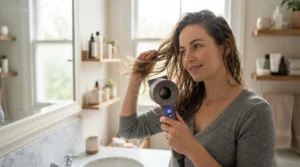
Retailer listings describe a 1600W dryer with three speeds, four heat settings, a 28°C cold shot and a Scalp Protect mode that lowers heat and airflow near your head. T3 reported that it reduces air to 55°C as it approaches the scalp. Pause Detect cuts the heat when you put it down, and Currys lists a two-year guarantee. That’s genuinely useful for heat styling, because it tackles the distance problem the dryer study highlighted. But Expert Reviews questioned whether around £400 is justified and noted that a good heat protector still does a lot of protective work. I agree with that framing. This is an upgrade, not a substitute for a cream.
Review sentiment is mostly editorial, and the verdicts vary by outlet. I’d read several before spending this much.
Pros:
- ✅ Intelligent heat control monitors air temperature
- ✅ 28°C cool shot setting sets styles
- ✅ Scalp Protect lowers heat near the head
Cons:
- ❌ Costs around £400, a large outlay
- ❌ Doesn’t coat hair like a cream does
Price: around £400 (check current price). Value verdict: only if you blow-dry daily and want a long-term tool.
Here’s how all seven stack up side by side:
| Product | Format | Size or key spec | Price range | Best For |
|---|---|---|---|---|
| Mark Hill Triple Threat | Cream | 200ml | Under £10 | Budget trials |
| Elvive Super Blowdry Cream | Cream | 150ml | Under £10 | Day-two restyling |
| All-Style Blow Dry | Primer | 150ml | Mid-to-high £20s | Volume |
| Netsu Design | Cream | 150ml | Around £35 RRP | Hold |
| Briogeo Farewell Frizz | Crème | 118ml | High-£30s | Frizz control |
| Moroccanoil All In One | Leave-in | 160ml | £35-£45 | One-bottle routines |
| Dyson Supersonic Nural | Dryer | 1600W, 4 heat settings | Around £400 | Heat reduction |
The pattern here is clear: you can reach a stated 230°C of protection for under £10, and the real differences are hold, finish and feel. Pay more for the primer or cream that matches your hair’s needs. Pay a lot more for the dryer only if daily blow drying makes the heat reduction worthwhile.
✨ Don’t Miss These Exclusive Deals!
🔍 Take your blow-dry routine to the next level with these carefully selected products. Click on any highlighted item to check current pricing and availability. These picks will help you create smoother, healthier-looking results you’ll love!
Your Step-by-Step Blow-Dry Routine (No Spray Required)
A cream or primer behaves differently from a mist, and most disappointments come from technique rather than the product. Here’s the routine I’d follow, based on the research and the instructions on the listings above.
- Towel-dry gently. Aim for damp, not dripping. Wet hair takes more dryer time, which means more heat exposure.
- Warm a small amount between your palms. Start with a pea-sized amount for fine hair and a walnut-sized amount for thick hair, then add more only if needed.
- Work it from mid-lengths to ends. The ends are the oldest part of the hair shaft and need the most protection.
- Comb through with a wide-tooth comb. This replaces the mist’s even spread, and it’s the step that spray users often skip.
- Keep the dryer moving at roughly 15 cm. The dryer study found this distance and continuous motion kept hair around 47°C.
- Dry in sections. Clip up the top layers and work through the underneath first.
- Finish with a cool shot. More on that below.
For maintenance, use a clarifying shampoo roughly once a month if you notice build-up. Common first-30-day mistakes include using too much cream (hair looks greasy), applying it to the scalp, and layering several products that each contain heavy silicones.
Real-World Scenarios: Which Alternative Fits Your Routine?
Specs only matter if they fit your life, so here are three profiles with the reasoning behind each match.
The commuter with fine hair, blow-drying three mornings a week, on a tight budget. I’d start with Mark Hill Triple Threat or Elvive Super Blowdry Cream, both under £10, using a pea-sized amount. The saving matters, but so does the lightness. If your hair flattens quickly, avoid richer creams until you’ve trialled a small amount.
The long-haired, colour-treated professional who wants a salon-style blow-dry once or twice a week, mid-range budget. Bumble and bumble All-Style Blow Dry gives you the primer finish and volume, and Netsu Design gives you hold that reactivates with heat. If your colour is fresh, apply more to the ends than the roots. Colour-treated hair arrives at the dryer already compromised.
The thick, frizz-prone hair owner who blow-dries daily and has room in the budget. Briogeo Farewell Frizz is the sensible cream here, and the Dyson Supersonic Nural is the long-term upgrade. Reviewers and retailers describe the Dyson’s Wave+Curl diffuser as aimed at natural patterns, which is relevant if your frizz comes from texture. Pair the two and you’ve cut the heat and added a coating.
Heat Styling Barrier: What Actually Sits Between Your Hair and the Heat?
A heat styling barrier is a film that coats the hair shaft, usually built from silicones, polymers, waxes or oils. It slows heat transfer and helps trap moisture, in much the same way sun cream sits between skin and UV. Shu Uemura’s listing is a good example, with dimethicone and beeswax doing the coating. Briogeo markets a silicone-free route, so the barrier idea isn’t tied to one chemistry.
Why does it matter? Research on heat-damaged hair models describes how high temperatures disrupt disulfide bonds in keratin, which is the primary reason frequent dryer use can leave hair fragile and prone to breakage. Dryer air is far cooler than a 230°C straightener, but the damage is cumulative.
There are limits worth stating plainly. The temperature ratings on packs are brand claims from instrumental tests, not guarantees. A barrier won’t rescue hair you hold 5 cm from a hot nozzle. And no format, whether cream, primer or spray, is proven to be universally superior. What the evidence supports is using something, keeping the dryer moving and avoiding extreme heat.
Leave-In Heat Protector Instead of Spray: When It Makes Sense
Switching to a leave-in heat protector instead of spray makes the most sense when you blow-dry from damp hair, since most creams are designed for that moment. Hands-on application also means you can’t miss a patch, which is the classic mist failure. You also get conditioning in the same step, so one product does two jobs, as with Moroccanoil All In One.
It makes less sense in two situations. First, day-two touch-ups. Marie Claire’s heat protectant guide points out that if you use hot tools on day two or three, you need a product that can be applied to dry hair, so check the label. Second, very fine hair that flattens under any cream. Here, a light formula in a tiny amount, such as Mark Hill Triple Threat, is the safer trial.
A useful rule: if you wash and blow-dry in one go, choose a cream. If you restyle between washes, choose something rated for dry hair, or one that reactivates with heat, like Elvive Super Blowdry Cream.
Blow-Dry Primer for Heat Protection: How It Differs from a Spray
A blow-dry primer for heat protection does two jobs at once. It shields the hair, and it preps the hair to hold a shape, add volume or smooth frizz. Bumble and bumble All-Style Blow Dry is described as exactly that, and Shu Uemura’s listing says its cream “primes” hair for heat styling.
The practical difference from a spray is texture and intent. A spray mostly protects. A primer protects and styles, which means it can replace a mousse or smoothing balm. That’s efficient, but it carries a risk of over-layering. If you apply a primer plus a leave-in plus a styling cream, hair can feel coated and heavy. Choose one hero product and add a second only if your hair truly needs it.
Another point: primers vary in how much heat they claim to handle. Some state a 230°C ceiling, while others only say “heat protection”. If you also straighten, look for a stated number. If you only blow-dry, the lack of a number is less critical given how much cooler dryer air is than a flat iron.
Cool Shot Setting: The Free Step Most People Skip
The cool shot setting is a button on most dryers, and it costs nothing. It blows unheated air so the style cools in place, and the shape tends to lock in as the hair cools. It also gives your hair a break from hot air near the end of the session.
The dryer study shows why reducing heat matters. At 15 cm, hair reached about 47°C and took 60 seconds to dry. At 10 cm it hit about 61°C in 30 seconds, and at 5 cm it reached about 95°C in 15 seconds. Faster drying at close range came at the cost of more cuticle damage. Pairing moderate heat, a steady 15 cm distance and a cool finish is the cheapest protective habit available.
The Dyson Supersonic Nural makes the step precise, with a listed 28°C cold shot. But you don’t need a premium dryer to benefit. Even a basic model’s cold button works. Use it after each section, not just at the end, if you’re setting curls or a smooth finish.
How to Choose Alternatives to Heat Protection Spray for Blow Drying
Choosing between creams, primers and hardware comes down to six checks. Work through them in order.
- Check your hair’s thickness. Fine hair suits lightweight creams in small amounts, while thick or coarse hair can handle richer formulas, as Byrdie-style roundups commonly note.
- Match the temperature rating to your tools. If you only blow-dry, a stated 230°C is more than enough. If you straighten, pick a product with a stated figure.
- Decide what else you want it to do. Volume points to a primer, hold to a cream like Netsu Design, and a simple routine to an all-in-one like Moroccanoil All In One.
- Consider your wash schedule. If you restyle between washes, look for heat-reactivated or dry-hair-friendly formulas.
- Weigh the cost per use. A 200ml budget cream may outlast a 118ml premium tube many times over.
- Decide whether hardware is worth it. If you blow-dry daily, a dryer with intelligent heat control may justify the outlay. If not, spend on product and technique.
Creams and Primers vs Heat Protection Sprays: A Straight Comparison
Here’s a five-row comparison of how the formats differ in everyday use.
| Factor | Cream or primer | Spray |
|---|---|---|
| Application | Hands-on, evenly worked through | Quick mist, can be uneven |
| Conditioning | Often built in | Usually lighter |
| Dry-hair touch-ups | Often not suitable | Often designed for it |
| Hold and volume | Frequently adds both | Rarely adds either |
| Best For | Briogeo Farewell Frizz, All-Style Blow Dry | Quick, light protection |
Reading the table, creams and primers win on coverage, conditioning and styling, while sprays win on speed and dry-hair convenience. Neither is universally better, and this is the honest answer to the question of alternatives to heat protection spray for blow drying. The right choice depends on whether you restyle between washes and how much your hair needs.
Common Mistakes When Switching Away from Spray
The biggest mistake is using too much. A cream applied in handfuls leaves hair greasy and heavy, and you can’t undo that without washing. Start with a pea-sized amount.
The second is applying to the scalp. Work from mid-lengths to ends, because the ends are the oldest and most fragile part of the hair.
Third, trusting the product to cancel out bad technique. The dryer study showed that close-range heat damaged hair even without the product element. A cream doesn’t excuse holding the dryer 5 cm from your head.
Fourth, ignoring temperature realities. Research from the Society of Cosmetic Chemists notes that thermal treatment above 100°C caused irreversible structural changes to hair fibre, and that repeated blow-dry cycles at around 75°C caused cracks at the edges of the cuticle. That’s a reminder that even “moderate” heat is cumulative.
Finally, stacking silicones. If you use a cream, primer and styling balm together, build-up is likely. Clarify monthly and simplify your routine.
Price Range & Value: What Does Each Option Really Cost?
Value depends on how often you blow-dry and how much product you use. Here’s a tiered view, using ranges only.
| Tier | Typical outlay | What you get | Best For |
|---|---|---|---|
| Budget cream | Under £10 | Stated 230°C, large size | Mark Hill Triple Threat, Elvive Super Blowdry Cream |
| Mid-range primer or cream | Roughly £25-£40 | Hold, volume, frizz control | All-Style Blow Dry, Netsu Design, Briogeo Farewell Frizz |
| Multi-benefit leave-in | Roughly £35-£45 | Conditioning plus thermal protection | Moroccanoil All In One |
| Smart dryer | Around £400 | Lower heat at source, cool shot | Dyson Supersonic Nural |
Total cost of ownership tells the clearest story. A budget cream costs pennies per use and does the barrier job. A mid-range cream costs more but may replace a styling product. The dryer is a multi-year purchase, so it only pays off if you blow-dry often. For most readers, the sensible spend is a cream or primer first, and the dryer later if daily use makes it worthwhile.

FAQ
❓ Is leave-in conditioner enough heat protection for blow drying?
❓ Can you use a blow-dry cream on dry hair?
❓ Does the cool shot setting really protect hair?
❓ What temperature does a blow-dry primer protect up to?
❓ Is a smart hair dryer a substitute for a heat styling barrier?
Conclusion
Alternatives to heat protection spray for blow drying are easy to find once you stop thinking of the mist as the only shield. Creams and primers coat the hair through hands-on application. A smart dryer lowers the heat before it reaches you. And the free tricks, a steady 15 cm distance and a cool shot setting, do more than most bottles.
If I had to give one practical order of operations, it would be this. Start with a budget cream such as Mark Hill Triple Threat or Elvive Super Blowdry Cream to test whether a leave-in heat protector instead of spray suits your hair. Step up to All-Style Blow Dry, Netsu Design or Briogeo Farewell Frizz if you want hold, volume or frizz control. Add Moroccanoil All In One if you want to simplify your shelf. And consider the Dyson Supersonic Nural only if daily blow drying makes the cost worthwhile.
The honest caveat is that temperature ratings are brand claims and no format is proven universally best. What the evidence does support is using something, keeping the dryer moving and avoiding close-range heat.
✨ Ready to build your spray-free blow-dry routine?
🌟 Click on any highlighted product above to check current pricing and availability, and give your hair the protection it deserves!
Recommended for You
- Heat Protection Spray For Hard Water Hair: 7 Best Picks (2026)
- Travel Size Heat Protection Spray For Curling Tongs: 7 Best (2026)
- Steam Rollers For Volume: 7 Brilliant UK Picks (2026)
Disclaimer: This article contains affiliate links. As an Amazon Associate, I earn from qualifying purchases. If you purchase products through these links, we may earn a small commission at no additional cost to you.
✨ Found this helpful? Share it with your friends! 💬🤗
