
In This Article
Nobody warns you about it in the adverts, but hold anything above your shoulder for ten straight minutes and your arm starts sending increasingly rude messages to your brain. An ergonomic hair dryer is built to quieten those messages down — lighter housings, better-balanced barrels, and handles shaped around how a wrist actually bends, rather than how a factory mould happens to come out. If you’ve ever swapped hands halfway through a blow-dry because your dominant arm gave up, or propped your elbow on the sink for support, you already understand the problem this category solves.
This isn’t a niche concern, either. Hairdressers spend entire shifts holding dryers overhead, and research on the profession is genuinely eye-opening: shoulder pain affects a huge proportion of stylists, and hand or wrist issues aren’t far behind. You don’t need to be a professional to feel the same strain at home, particularly if you have thick or long hair, arthritis, a previous injury, or simply average-sized hands wrapped around an over-large grip. The good news is that hair dryer engineering has moved on enormously in the last few years — brushless digital motors, motor-in-handle designs, and genuinely thoughtful weight distribution mean you no longer have to choose between drying power and a pain-free arm.
Below, we’ve researched seven real, currently available models spanning budget to premium, each assessed specifically through an ergonomic lens: weight, balance, button placement, and how forgiving they are on wrists, hands and shoulders. As the Health and Safety Executive notes, upper limb disorders are made worse by prolonged, repetitive one-handed tasks — which describes blow-drying pretty accurately. We’ll walk through genuine specs, honest analysis of who each dryer suits, real aggregated review sentiment, and practical guidance for using whichever one you choose without doing your joints any favours in the wrong direction.
Quick Comparison Table
| Dryer | Weight | Power | Best For | Price Range |
|---|---|---|---|---|
| Dyson Supersonic | ~560g | 1,600W | All-round comfort, heat-sensitive hair | £250-£400 |
| GHD Helios | ~485g | 2,100W | Fast, balanced everyday styling | £130-£170 |
| Parlux Alyon | ~455g | 2,250W | Power without the weight penalty | £120-£180 |
| T3 AireLuxe | ~480g | 1,875W | Control freaks who still want it light | £150-£190 |
| mdlondon BLOW | 360g | 1,600W | Lightest grip, travel, weak wrists | £180-£200 |
| BaByliss Power Smooth 5736CU | ~430g | 2,400W | Budget-friendly comfort | £30-£45 |
| Remington D3190 | ~450g | 2,200W | Value with an ergonomic handle | £25-£40 |
A quick glance tells its own story here: weight and price don’t move together in lockstep the way you might expect. The mdlondon BLOW is the lightest dryer on this list by a wide margin, yet it sits mid-pack on price, while the far heavier premium options justify their cost through motor technology and heat control rather than raw grams saved. If arm fatigue is your single biggest concern, weight is the column to study first; if you’re managing a specific hand condition, balance and button placement (which we cover product-by-product below) matter just as much as the number on the spec sheet.
💬 Just one click — help others make better buying decisions too!😊
Top 7 Ergonomic Hair Dryers: Expert Analysis
1. Dyson Supersonic — motor-in-handle balance that spares your wrist
Dyson moved the motor from the traditional head position into the handle itself, and that single decision is arguably the most significant ergonomic innovation in hair dryer design this decade. Rather than holding a device that’s front-heavy and constantly trying to tip forward out of your grip, you’re holding something whose weight sits directly over your hand, which means your wrist muscles aren’t fighting a lever arm every single second of use.
On specs, the digital motor V9 spins at up to 110,000rpm inside a housing that weighs around 560g, considerably less than the 700g-plus that traditional AC-motor dryers commonly hit. Airflow is drawn in and then amplified roughly threefold, which is why Dyson can dry hair quickly at lower heat settings — the intelligent heat control measures air temperature more than 40 times a second, cutting the risk of overheating both your hair and, less obviously, the barrel itself under your fingers.
Who genuinely benefits here: anyone managing existing wrist or shoulder discomfort who wants one dryer for years rather than a replacement every eighteen months, and anyone with fine or colour-treated hair who also cares about heat damage. Reviewers consistently note that the dryer feels noticeably front-light compared with rivals, and multiple independent testers have specifically praised how “engineered for balance” plays out in real, extended styling sessions rather than just marketing copy. A recurring theme in aggregated feedback is that the trigger buttons sit slightly awkwardly for very small hands, which is worth trying in person if you can.
Pros:
- ✅ Motor-in-handle design keeps weight centred over your grip
- ✅ Intelligent heat control reduces both hair and hand-side heat exposure
- ✅ Long 2.8m cord means less reaching and twisting mid-style
Cons:
- ❌ Premium price puts it out of reach for casual users
- ❌ Buttons can feel fiddly for smaller hands during long sessions
At around £250-£400 depending on the exact edition and attachment set, the Supersonic sits firmly in “considered investment” territory rather than an impulse buy. Based on the spec comparison against the rest of this list, the value case rests on longevity and the balance-first design rather than sheer wattage — if you dry your hair daily and have any history of arm or shoulder strain, the cost-per-use maths tends to work out favourably over several years.
2. GHD Helios — brushless motor, lighter housing, faster dry
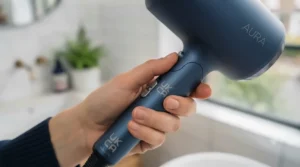
The GHD Helios weighs in at roughly 485g, a meaningful drop from GHD’s older Air model, achieved largely through its switch to a brushless motor. Brushless motors use magnets and electronics rather than physical carbon brushes to spin the fan, and one welcome side effect of that shift is that the motor itself is both lighter and quieter, which lets GHD trim material elsewhere in the housing without the dryer feeling flimsy.
What most buyers overlook about this model is that the weight saving isn’t just about the number on the box — a brushless motor also runs cooler, meaning less heat transfers back into the barrel and handle during a long drying session. Combined with the 2,100W output, testers have found it dries hair quickly and evenly without leaving damp patches at the root, which in practice means shorter total holding time even before you factor in the lighter build.
This is a strong fit for anyone who dries their hair daily and wants speed and comfort in one package without stepping up to Dyson pricing. Reviewers consistently report that the ergonomic handle balances the weight well even during longer sessions, and one detailed comparison specifically noted it as the “fast dryer” pick precisely because of how little arm fatigue testers experienced relative to how briskly it worked. The trade-off, according to aggregated feedback, is that the control set is deliberately minimal — heat, speed, and a cool shot, nothing more — which some buyers coming from more feature-packed dryers found underwhelming.
Pros:
- ✅ Brushless motor cuts both weight and handle-side heat
- ✅ Strong, even airflow reduces total drying time
- ✅ Simple three-control layout means less fumbling one-handed
Cons:
- ❌ Heavier than the very lightest models on this list
- ❌ Minimal settings won’t suit buyers wanting granular control
Priced in the £130-£170 range, the Helios lands in the sensible middle ground of this comparison. Here’s what to weigh: you’re paying a premium over budget dryers specifically for the brushless motor’s weight and heat advantages, and for most people drying hair several times a week, that translates into a genuinely more comfortable routine rather than just a shinier badge on the box.
3. Parlux Alyon — Italian engineering built for salon-length shifts
Professional hairdressers spend entire working days holding a dryer, so it’s no surprise that a brand built for salons ended up producing one of the more genuinely ergonomic options on the consumer market. The Parlux Alyon weighs around 455g and pairs that with a K-Advance Plus motor delivering 2,250W and roughly 84 cubic metres of airflow per hour — enough grunt that stylists don’t need to compensate for a lighter build by holding the dryer closer or angling their wrist awkwardly.
The redesigned handle is the detail worth dwelling on: Parlux specifically repositioned the heat and speed switches to sit under the fingers in what the brand calls “the most ergonomic position,” rather than requiring a thumb stretch across the barrel. Based on the spec comparison, this matters more than it sounds — switch position affects grip angle throughout an entire drying session, and an awkward reach repeated dozens of times per style is exactly the kind of micro-strain that adds up over months.
This is squarely a dryer for people who dry their hair often, have thick or long hair that takes a while to finish, or who’ve previously found their wrist aching by the final section. Reviewers consistently note the Alyon’s balance and lightness relative to its power output, with several long-term users specifically citing it as a step up from cheaper dryers precisely because their arm no longer tires before their hair finishes drying. The antimicrobial silver-powder coating is a nice hygiene touch that’s rarely mentioned by rivals at this price.
Pros:
- ✅ Switches positioned for natural finger reach, not thumb stretch
- ✅ High airflow-to-weight ratio suits thick or long hair
- ✅ Antimicrobial coating adds a hygiene edge over rivals
Cons:
- ❌ No diffuser included as standard with most colourways
- ❌ Two-pin plug on some non-UK listings needs checking before buying
Typical UK pricing sits around £120-£180 depending on colourway and retailer. What the spec sheet won’t tell you, but reviewers note, is that this dryer holds its resale and reputation value unusually well among professionals — a reasonable proxy for genuine day-to-day reliability rather than a device that looks good in a launch video and fades after a year of real use.
4. T3 AireLuxe — five heat settings without sacrificing lightness
Most dryers on this list offer three heat settings; the T3 AireLuxe offers five, plus a volume boost switch, while still landing at a lightweight build that testers have specifically flagged as “impressively lightweight for a full-sized model.” That combination — more control without more mass — is the AireLuxe’s whole pitch, and it’s a genuinely useful one for anyone whose hair type varies by season or who colours their hair regularly and needs finer heat gradation than a basic low/medium/high dial allows.
The “RapidAire IQ technology” widens the airflow path to speed up drying, which in practical terms means fewer total minutes with your arm raised — a meaningful ergonomic benefit even though it’s marketed as a speed feature rather than a comfort one. Here’s what to weigh: five heat settings sound like a small thing, but for hair that’s fine at the roots and coarser at the ends, being able to dial down heat precisely rather than guessing between “too hot” and “too gentle” reduces the temptation to redo sections, which is where a lot of unnecessary extra holding time comes from.
Testers found the maximum heat setting could have run a touch hotter for very thick hair, so if you regularly dry very coarse or very long hair, this may not be the fastest option here even with its extra controls. It suits people who value precision and are managing sensitive skin or scalp conditions where consistent, gentle heat matters more than outright drying speed.
Pros:
- ✅ Five heat settings allow precise, gentle drying
- ✅ Lightweight build despite the extra control options
- ✅ Volume boost switch adds versatility without extra weight
Cons:
- ❌ Maximum heat can feel underwhelming on very thick hair
- ❌ Diffuser and comb are sold separately, adding to total cost
At roughly £150-£190, the AireLuxe sits close to the GHD Helios in price. On paper this means you’re choosing between GHD’s raw speed-and-balance combination and T3’s extra granularity of control — a genuinely personal trade-off rather than one model being objectively superior.
5. mdlondon BLOW — the lightest full-power dryer you can buy
At 360g without its cable, the mdlondon BLOW is comfortably the lightest dryer in this comparison, and it achieves that through a distinctive T-shaped design rather than by simply using cheaper, flimsier materials. The barrel is longer and thinner than a conventional dryer, and the handle sits more centrally along that barrel, which distributes weight front-to-back rather than leaving it all clustered at the head — the same balance principle Dyson pursued, achieved through a completely different shape.
The 1,600W brushless DC motor is genuinely the standout feature here from an ergonomic standpoint, not because it’s the most powerful (it isn’t, on paper) but because brushless motors are inherently more efficient, letting mdlondon reach a genuinely low overall weight without gutting drying performance. One detailed reviewer specifically noted that the design “makes it advantageous for mobility issues where holding heavy things, and holding them up, is very difficult” — a direct, honest acknowledgement that this dryer was designed with exactly the audience reading this article in mind.
If you have limited grip strength, arthritis, a shoulder injury, or you simply have small hands that struggle to wrap around a bulky traditional barrel, this is the dryer most worth trying first. Reviewers consistently praise how manoeuvrable it is when switching between the front and back of the head mid-style, something that’s genuinely awkward with heavier dryers. The narrower barrel also means you can get closer to the roots, which particularly helps with fine or curly hair.
Pros:
- ✅ Lightest dryer here by a significant margin, at 360g
- ✅ T-shape balances weight for easier one-handed manoeuvring
- ✅ Quiet Mark certified, useful for early mornings or shared homes
Cons:
- ❌ Rough-drying results are slower without the concentrator attached
- ❌ Premium price for a lower-wattage motor than rivals
Priced around £180-£200, the BLOW isn’t cheap for its wattage, and the value case genuinely rests on the ergonomic case rather than raw drying power. If arm fatigue, grip strength, or wrist pain is your central problem, though, the cost-per-use argument tips firmly in its favour — a dryer you can actually hold comfortably for its full lifespan beats a more powerful one that ends up back in the drawer after a few uncomfortable uses.

6. BaByliss Power Smooth 5736CU — budget power that doesn’t punish your arm
It would be easy to assume a hair dryer under £45 has to compromise on comfort to hit that price point, but the BaByliss Power Smooth 5736CU is a useful reminder that isn’t always true. At roughly 430g with a 2,400W motor — genuinely more powerful on paper than several dryers costing three or four times as much on this list — it maintains a build that UK buyers consistently describe as comfortable for extended styling sessions rather than something you’re clock-watching through.
The three heat and two speed settings plus ionic technology cover the basics competently, and the standout advantage of ionic conditioning specifically for arm comfort is indirect but real: ions help break down water molecules faster, meaning less total drying time and, by extension, less time your arm spends raised. Reviewers consistently note that thick, coarse hair dries markedly faster than expected for the price, which is exactly the kind of practical detail that matters more day-to-day than a spec sheet number.
This is the pick for students, renters, anyone testing whether an ergonomic-leaning dryer actually changes their experience before committing to a premium model, or simply anyone who wants a comfortable, no-fuss backup dryer for a second bathroom or for travel within the UK. Aggregated customer sentiment repeatedly draws direct comparisons to considerably pricier dryers, with several buyers specifically noting they couldn’t tell much difference in daily use.
Pros:
- ✅ High 2,400W output despite a genuinely low price
- ✅ Comfortable, lightweight build for extended sessions
- ✅ Ionic technology cuts total drying time
Cons:
- ❌ Build quality feels noticeably plainer than premium rivals
- ❌ No diffuser included, limiting styling versatility
At around £30-£45, this is the clearest value pick on the list by a wide margin. Reviewers consistently note that the ergonomic handle and manageable weight are the main reasons it punches above its price bracket, rather than any single standout technical feature — sometimes “comfortable and sensible” beats “flashy and expensive” for genuine everyday use.
7. Remington D3190 — an affordable dryer that doesn’t ignore your grip
The Remington D3190 is a 2,200W full-size dryer built around ceramic, ionic and tourmaline technology, and while none of those three buzzwords is unique to Remington, the combination genuinely does what it claims: faster, more even heat distribution with reduced static. What’s more relevant here is that Remington specifically designed the handle to be ergonomic, describing it directly as shaped for comfortable handling — not an afterthought bolted onto an existing shell.
At roughly 450g, it’s neither the lightest nor the heaviest dryer on this list, sitting closer to the mid-pack. The Dual Fan Technology increases airflow volume without a corresponding jump in motor size or weight, which is the detail that actually matters for comfort: more air moved per gram of housing is a genuinely useful ratio, even if it doesn’t sound as glamorous as a headline wattage figure. The three heat and two speed settings plus a dedicated turbo function give reasonable flexibility for a dryer at this price point.
This suits barbers, students, and budget-conscious buyers who want the peace of mind of a recognisable, established brand rather than an unfamiliar name, alongside genuinely serviceable comfort during use. Real UK customer feedback repeatedly highlights the ergonomic handle specifically, alongside praise for how quickly thick or coarse hair dries relative to the price bracket — a pattern that suggests the comfort claims aren’t just marketing copy.
Pros:
- ✅ Ergonomic handle explicitly engineered, not an afterthought
- ✅ Dual Fan Technology boosts airflow without extra bulk
- ✅ Turbo function adds speed flexibility for thick hair
Cons:
- ❌ Plastic build feels less premium under sustained daily use
- ❌ Fewer heat gradations than pricier rivals like the T3 AireLuxe
Priced around £25-£40, the D3190 is squarely a budget pick, and the honest verdict is that it delivers reasonable ergonomic thinking at a price where many rivals cut corners on the handle entirely. For occasional or light daily use, it represents solid value; for daily professional-style use, the Parlux or GHD above will likely outlast it.
Practical Usage Guide: Setting Up Your Dryer to Protect Your Arm
Buying a lighter dryer solves half the problem — how you use it solves the other half. In your first week, resist the urge to hold the dryer at head height the entire time; instead, rest your elbow briefly against your body or a nearby surface between sections, which takes the constant static load off your shoulder. Check the cord length before you buy attachments or accessories: a cable under 2m forces you into awkward stretched postures near the socket, which cancels out much of the ergonomic benefit of a lighter head unit.
During the first 30 days, the most common mistake is gripping too tightly out of habit from a heavier, older dryer — a lighter model needs a lighter hold, and consciously relaxing your grip reduces forearm tension considerably. Clean the removable filter monthly; a clogged filter forces the motor to work harder, which on some models increases vibration transmitted directly into your hand, undoing some of the ergonomic design. Finally, switch drying hands periodically during a single session if you can manage it — even the best-balanced dryer benefits from not loading exactly the same muscles for the entire routine.
For anyone specifically managing joint pain, the NHS notes that repetitive strain injury symptoms often ease with activity modification and shorter, more frequent breaks rather than pushing through discomfort — advice that applies directly to a five-to-fifteen-minute daily blow-dry as much as it does to any other repeated task.
Real-World Scenarios: Matching the Dryer to the Person
Sarah, 34, has early-stage rheumatoid arthritis and struggles with grip strength most mornings. For her, the mdlondon BLOW’s 360g weight and T-shape design are the standout features — she needs a dryer that doesn’t require sustained tight gripping, and the balanced barrel means she can rest it more loosely in her palm without it tipping forward.
Tom, 45, is a part-time barber working three days a week from a small home studio. He needs genuine drying power to keep client appointments moving, alongside a build that survives daily professional use. The Parlux Alyon suits him well: salon-grade airflow, a handle specifically designed around all-day holding, and a price that makes sense for someone using it dozens of times a week rather than a handful.
Priya, 26, is a student on a tight budget with long, thick hair that takes ages to dry. She doesn’t need premium branding, but she does need something that won’t leave her arm aching through a lecture-day rush. The BaByliss Power Smooth 5736CU gives her genuine 2,400W power and a manageable weight for well under £50 — proof that ergonomic thinking doesn’t have to come with a premium price tag attached.

How to Choose an Ergonomic Hair Dryer
- Check the weight first, always in grams rather than marketing adjectives. Anything under 500g is genuinely light by current standards; anything over 600g will be noticeable during longer sessions.
- Look for motor-in-handle or brushless motor designs. Both tend to shift weight back over your grip and run cooler against your hand, which matters more than raw wattage for comfort.
- Check switch and button placement, not just their existence. Controls positioned for a natural finger reach beat ones requiring an awkward thumb stretch, especially over a long session.
- Consider cord length alongside the dryer itself. A cable under 2.5m often forces stretched, awkward postures that undo a lighter head unit’s benefits.
- Match heat settings to your actual hair type, not the highest number on the box. More granular control reduces redone sections, and fewer redone sections means less total time holding the dryer up.
- Factor in noise if you’re sensitive to vibration. Quieter, vibration-dampened motors are generally gentler on hands already prone to discomfort.
- Read aggregated review sentiment for your specific concern — arthritis, RSI, small hands, or simple daily fatigue — rather than general star ratings, since a dryer can be excellent overall while still being wrong for your particular grip or condition.
Ergonomic Hair Dryers vs Traditional Hair Dryers
Traditional dryers, particularly older AC-motor models still sold at rock-bottom prices, typically weigh 600-900g with the motor housed in the head — the heaviest, furthest-from-your-hand part of the device. That positioning creates a lever effect: every gram in the head effectively feels heavier by the time the strain reaches your wrist and shoulder, compared with the same weight positioned in the handle.
Ergonomic and lightweight designs address this in two distinct ways. Motor-in-handle designs, as Dyson pioneered, physically relocate the mass. Brushless motor designs, used by GHD, Parlux, and mdlondon among others, instead reduce the total mass needed in the first place, since brushless motors don’t require the bulkier magnets and carbon-brush assemblies of older AC motors. Both approaches land in a similar place — a lighter, more centred device — but the underlying engineering differs, and it’s worth knowing which route a given dryer took if you’re comparing two similarly weighted options, since brushless motors also tend to run cooler and last longer with less maintenance.
The comparison isn’t entirely one-sided, though: traditional heavier dryers are sometimes marginally more powerful for their price, since motor efficiency innovations tend to arrive at a premium first before filtering down. For anyone without existing hand, wrist, or shoulder concerns, a traditional budget dryer may still represent reasonable value; the ergonomic category earns its price premium specifically for people who feel the weight.
Hair Dryers for Arthritis and Limited Grip Strength
Hand or wrist arthritis changes the calculation around hair dryer choice considerably, because the issue often isn’t just total weight but sustained gripping itself. Versus Arthritis, the UK’s leading arthritis charity, notes that everyday tools with chunky, easy-grip handles and reduced need for sustained force can make a meaningful difference to daily tasks for people managing joint pain — guidance that applies directly to hair dryer handle design, not just kitchen utensils.
In practice, this means the barrel shape and grip diameter matter as much as overall weight. A dryer with a narrow, hard-edged handle can be genuinely painful to hold for someone with swollen finger joints, even if it’s objectively lightweight on the scales. The mdlondon BLOW’s wider, more centrally balanced handle and the Parlux Alyon’s redesigned switch placement both reduce sustained gripping force compared with a conventional barrel-and-trigger design, which is worth prioritising over shaving off a further 20-30g if your main issue is joint pain rather than pure muscle fatigue.
It’s also worth considering a lightweight stand or wall mount if your grip strength varies day to day with flare-ups — several users in aggregated reviews specifically mention pairing a lighter dryer with a simple stand for days when even a 360g device feels like too much to hold unsupported.
Long-Term Cost and Maintenance
Cheaper dryers aren’t automatically false economy, but the total cost of ownership calculation looks different once you factor in comfort-driven replacement cycles. A £30 dryer that causes enough wrist discomfort to sit unused after six months, replaced by another £30 dryer with the same problem, ends up costing more over three years than a single £150 dryer genuinely designed to be held comfortably for its full working life.
Maintenance itself is straightforward across every model here: clean the rear filter monthly to prevent motor strain (which, as noted above, can increase vibration transmitted to your hand), avoid coiling the cord tightly around the barrel for storage since this stresses the internal wiring at the handle junction, and store the dryer somewhere it won’t get knocked, since a dropped dryer can develop an internal balance issue that undoes its ergonomic design even if it still technically works. Brushless motor dryers (GHD Helios, Parlux Alyon, mdlondon BLOW) generally need less internal maintenance over their lifespan than older AC-motor equivalents, since there are no carbon brushes to wear down and eventually replace.
Features That Actually Matter (And Those That Don’t)
Genuinely worth prioritising: overall weight, motor type (brushless generally beats AC for both comfort and longevity), handle diameter relative to your own hand size, and switch placement. These four factors do the heavy lifting — pun intended — for comfort during actual use.
Largely marketing noise for the ergonomic-focused buyer: headline wattage above roughly 1,800W (diminishing returns for most hair types), the number of included attachments (nice to have, irrelevant to arm comfort), and colour options. A 2,400W dryer isn’t meaningfully faster than a well-designed 1,875W one for the vast majority of hair types — the difference shows up more in marketing copy than in a stopwatch.
Safety and Standards to Check Before Buying
Any hair dryer sold in the UK should carry UKCA or CE marking, confirming it meets relevant electrical safety standards, and should be purchased from a retailer offering a genuine manufacturer warranty rather than a grey-import listing without UK plug certification, which several reviewers specifically flagged as an issue with some third-party Parlux listings. If you’re using a dryer in a professional setting for extended daily periods, it’s worth cross-checking your setup against independent UK consumer guidance on hair dryer safety and performance testing, such as the ongoing reviews published by Which?, which regularly flag models with genuine safety or reliability issues alongside performance scores.
FAQ
❓ What makes a hair dryer 'ergonomic' rather than just lightweight?
❓ Is a lighter hair dryer always better for arm pain?
❓ Can an ergonomic hair dryer help with arthritis specifically?
❓ Do brushless motor hair dryers really last longer?
❓ How much should I expect to pay for a genuinely ergonomic hair dryer in the UK?
Conclusion
The right ergonomic hair dryer genuinely does change your daily routine, and not in a subtle way — the difference between finishing a blow-dry with a slightly tired arm and finishing one with a properly aching shoulder is almost entirely down to weight, balance, and handle design rather than luck or how “tough” you are about pushing through discomfort. Whether you land on the ultra-light mdlondon BLOW, the motor-in-handle balance of the Dyson Supersonic, or a genuinely comfortable budget option like the BaByliss Power Smooth, the seven models covered here represent honest, currently available choices across every price bracket, each assessed specifically against the question this article set out to answer: will this actually feel better to hold?
If you take one thing away, let it be this: try to handle a dryer in person before buying if you possibly can, since grip comfort is genuinely personal in a way that a spec sheet can’t fully capture. Combine the right dryer with the small usage habits covered above — shorter continuous holds, a relaxed grip, and the odd hand-swap mid-session — and you’ve got a routine that protects your joints for years, not just today’s blow-dry.
Recommended for You
- Lightest Hair Dryer 2026: 7 Ultra-Light Picks Under 400g
- 7 Best Quiet Professional Hair Dryers 2026: Salon Tested
- Quiet Hair Dryer for Baby Sleeping: 7 Best Low-Noise UK Picks 2026
Disclaimer: This article contains affiliate links. As an Amazon Associate, I earn from qualifying purchases. If you purchase products through these links, we may earn a small commission at no additional cost to you.
✨ Found this helpful? Share it with your friends! 💬🤗
