
In This Article
Stand in front of the straighteners aisle on amazon.co.uk for more than thirty seconds and you’ll start seeing the same two words everywhere: ceramic and titanium. They sound like a spec-sheet footnote, the sort of detail you skim past on your way to the price tag. That’s a mistake. The plate material is arguably the single biggest factor in how a straightener actually behaves in your hand — how fast it heats, how evenly it spreads that heat, and, crucially, how your specific hair type reacts to it. Get the ceramic vs titanium straighteners decision wrong and you’ll either be dragging the same section through your hair four times to get it straight, or scorching fine strands that never needed that much heat in the first place.

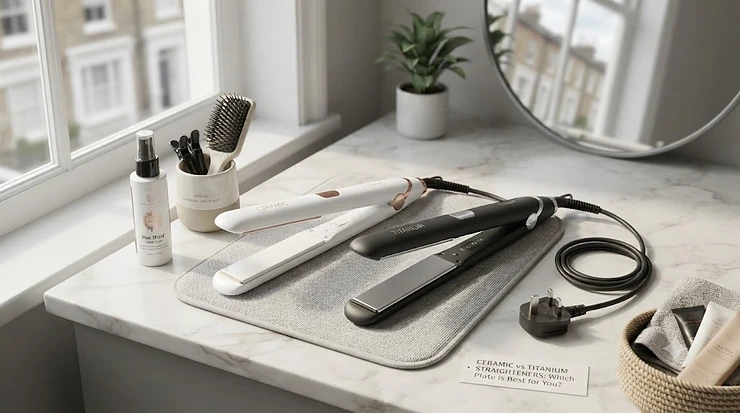
What is a ceramic vs titanium straightener comparison actually about? In short: ceramic plates heat gradually and distribute warmth evenly, making them gentler on fine or damaged hair, while titanium plates heat almost instantly and hold that heat under pressure, favouring thick, coarse or curly hair that resists at lower temperatures. Neither material is objectively “better” — they’re built for different jobs.
This guide pulls together real, currently available products from budget to premium, honest analysis of what the specs mean in practice, and aggregated review sentiment rather than invented anecdotes. We’ve dug into plate chemistry, heat conductivity, and the sort of everyday scenarios — thick hair on a humid commute, fine hair that fries if you look at it wrong — that actually decide which straightener earns a place on your bathroom shelf. By the end, you’ll know not just which of these seven tools suits you, but why, based on the physics of the plates rather than marketing copy.
Quick Comparison Table: Ceramic vs Titanium Straighteners at a Glance
| Product | Plate Material | Max Temp | Heat-Up Time | Best For | Price Range |
|---|---|---|---|---|---|
| Remington Ceramic Straight 230 S3500 | Ceramic | 230°C | ~30 sec | Budget everyday use | Under £30 |
| Remington Shine Therapy S8500 | Ceramic (argan-infused) | 230°C | ~15 sec | Fine to normal hair | £30-£45 range |
| Revamp Progloss Touch | Ceramic ionic | 230°C | ~20 sec | Curly, coarse hair | £45-£55 range |
| BaByliss Straight & Curl Brilliance | Titanium | 235°C | ~15 sec | 2-in-1 styling | £70-£100 range |
| Diva Pro Styling Ultra Fast Titanium | Titanium (floating) | 230°C | ~15 sec | Salon-frequency use | £50-£70 range |
| GHD Platinum+ | Ceramic (precision-milled) | 185°C fixed | ~20 sec | Thick, healthy hair | £180-£240 range |
| BaBylissPRO Nano Titanium | Nano titanium | 230°C | ~15 sec | Thick, resistant hair | £90-£130 range |
Looking at this table, the pattern that jumps out immediately is speed: every titanium model here hits working temperature in around 15 seconds, while the pure ceramic options need closer to 20-30 seconds unless they’re paired with a booster coating like Remington Shine Therapy S8500‘s argan infusion. That gap sounds trivial until you’re running late and reaching for the iron with wet ends still visible. Price tells its own story too — titanium’s faster heat recovery under pressure genuinely does command a premium, but as Diva Pro Styling Ultra Fast Titanium proves, that speed doesn’t have to cost GHD money.
💬 Just one click — help others make better buying decisions too!😊
Top 7 Ceramic and Titanium Straighteners: Expert Analysis
Choosing between ceramic and titanium isn’t really about which material wins a spec-sheet fight — it’s about matching a plate’s heating behaviour to your hair’s actual resistance. Below are seven genuinely different straighteners, spanning proper budget buys through to salon-grade kit, each broken down on specs, who it suits, and where real reviewers say it falls short.
1. Remington Ceramic Straight 230 S3500 — best budget entry point
The Remington Ceramic Straight 230 S3500 has become something of a fixture on “most recommended” UK straightener lists, and the reason isn’t complicated: it’s a genuinely competent ceramic iron sold at a price that undercuts almost everything else on this list.
Its ceramic-coated plates run across 30 individual temperature increments up to 230°C, which is more granular control than you’d expect at this price point — most rivals in the sub-£30 bracket offer three or four fixed settings, not thirty. In practice, that means you can dial in something closer to 170°C for fine, colour-treated hair without the iron defaulting to a punishing top-end heat.
Based on the spec comparison, this is a straightener built for people who want reliable, no-fuss results rather than salon-level speed — the ceramic coating heats gradually rather than instantly, so patience during the first pass pays off with more even results by the second. Reviewers consistently report that the Remington Ceramic Straight 230 S3500 performs well on normal-to-fine hair and struggles somewhat with very thick or tightly curled sections, needing multiple passes where a titanium iron would clear the same section once.
Pros:
- ✅ Thirty heat settings for genuinely fine temperature control
- ✅ Ceramic coating is gentle on fine or colour-treated hair
- ✅ Among the most affordable genuinely branded options available
Cons:
- ❌ Slower heat-up than titanium alternatives on this list
- ❌ Struggles on thick or very curly sections without repeat passes
Priced under £30 at the time of research, the Remington Ceramic Straight 230 S3500 represents strong value for anyone with fine-to-normal hair who isn’t chasing salon speed — check current price before buying, as availability shifts.
2. Remington Shine Therapy S8500 — best ceramic upgrade for fine hair
Where the S3500 keeps things basic, the Remington Shine Therapy S8500 adds a genuine functional upgrade: its Advanced Ceramic plates are infused with Moroccan argan oil and vitamin E, which is a real formulation choice rather than a marketing sticker, and reviewers do note a smoother, glossier finish compared with plain ceramic irons.
The infused coating heats to 230°C but recovers heat faster between passes than the basic S3500, largely because the oil-infusion process also refines the ceramic’s surface finish, reducing drag as the plates glide through hair. What most buyers overlook about this model is that the argan infusion isn’t purely cosmetic — a smoother plate surface means less mechanical snagging, which is a genuine contributor to split ends over time, not just a “shinier hair” gimmick.
This is the sort of straightener suited to someone with fine-to-medium hair who wants a step up from entry-level without jumping to titanium or three-figure pricing. Aggregated customer sentiment on this range is broadly positive, with users frequently mentioning the smoother glide and reduced frizz; a recurring criticism is that the plates, while wider than the budget model, still aren’t generous enough for very long or thick hair to style quickly.
Pros:
- ✅ Argan oil and vitamin E infusion improves glide and shine
- ✅ Faster heat recovery than basic ceramic models
- ✅ Strong value step-up for fine-to-medium hair types
Cons:
- ❌ Plates remain narrow for very long or thick hair
- ❌ Not the fastest option if you’re regularly short on time
At around the £30-£45 range at the time of research, the Remington Shine Therapy S8500 earns its slightly higher price tag through genuinely improved plate chemistry rather than cosmetic branding.
3. Revamp Progloss Touch Digital Ceramic Straightener — best ceramic for curly or coarse hair
It’s a common myth that ceramic automatically means “gentle but weak.” The Revamp Progloss Touch Digital Ceramic Straightener pushes back on that a little, using ionic ceramic plates with a digital touch display for more precise heat control up to 230°C, specifically marketed toward curlier, coarser hair types that usually get steered toward titanium by default.
The ionic technology is worth unpacking rather than just listing: as the plates heat, they emit negative ions that are claimed to break down water molecules on the hair shaft faster, which in principle reduces frizz and static during styling — a genuine point of differentiation from a plain ceramic coating, though the scale of the effect varies by hair porosity. Here’s what to weigh: on paper, the combination of ionic technology and digital heat precision gives curly-haired users finer control than a basic ceramic iron, without the harsher feel some titanium irons have on textured hair.
Reviewers with curly and coarse hair types report that the Revamp Progloss Touch Digital Ceramic Straightener handles resistant sections better than expected for a ceramic tool, though a recurring theme in aggregated feedback is that achieving pin-straight results on very tightly coiled hair still requires more passes than a titanium iron running at the same temperature.
Pros:
- ✅ Ionic ceramic plates reduce frizz and static during styling
- ✅ Digital display allows precise temperature control
- ✅ Performs well on curly and coarse hair for a ceramic tool
Cons:
- ❌ Still requires more passes than titanium on very tight curls
- ❌ Digital display adds cost versus basic dial controls
Sitting in the £45-£55 range at the time of research, the Revamp Progloss Touch Digital Ceramic Straightener is a smart middle-ground pick for anyone who wants ceramic’s gentleness without sacrificing performance on textured hair.
4. BaByliss Straight & Curl Brilliance — best 2-in-1 titanium for versatility
The BaByliss Straight & Curl Brilliance switches the conversation to titanium, and the spec sheet shows exactly why that material choice matters here: true titanium plates measuring 28mm wide by 120mm long, five heat settings up to 235°C, and a 15-second heat-up time with what BaByliss describes as “ultra-fast” heat recovery between passes.
That heat recovery figure is the detail worth dwelling on. Titanium’s molecular structure conducts heat more efficiently than ceramic, meaning that when the plates clamp down on a thick section of hair and pull heat away from the surface, they recover to target temperature far quicker than a ceramic plate would. In practice, that translates to fewer repeat passes on resistant hair, which matters more than the headline maximum temperature. The rounded barrel design and included cool tips also let this model double as a curling tool, adding genuine versatility rather than being a straightener with a curling gimmick bolted on.
Aggregated reviews frequently praise the dual straightening-and-curling function and the noticeably fast glide on thick hair, while a consistent complaint is that the narrower 28mm plate width, while good for control, does slow things down on very long hair compared with wider ceramic alternatives.
Pros:
- ✅ True titanium plates recover heat fast between passes
- ✅ Genuine 2-in-1 straightening and curling functionality
- ✅ Five heat settings up to 235°C for tailored control
Cons:
- ❌ Narrower 28mm plates take longer on very long hair
- ❌ Titanium’s efficient heat transfer needs a lighter touch on fine hair
At around £70-£100 at the time of research, the BaByliss Straight & Curl Brilliance is a genuinely versatile mid-range pick for anyone who wants one tool that does two jobs well.
5. Diva Pro Styling Ultra Fast Titanium — best titanium for salon-frequency use
The Diva Pro Styling Ultra Fast Titanium is the straightener that keeps coming up when UK salons talk about the tool they reach for during a full day of back-to-back clients, and the reasoning centres on its floating titanium plates and genuinely rapid heat recovery system.
Floating plates matter more than they sound like they should: rather than being rigidly fixed, the plates pivot slightly to maintain even pressure across sections of varying thickness, which reduces snagging and, combined with titanium’s inherent conductivity, keeps the surface temperature consistent even as you work through thick or coarse hair at pace. Based on the spec comparison, this model doesn’t chase the highest possible maximum temperature — instead, it optimises for speed of recovery, which is the metric that actually determines how many passes you need on resistant hair.
What most buyers overlook about titanium irons generally, and this one specifically, is that you rarely need the maximum setting to get a lasting result; the plates are efficient enough that a mid-range heat outperforms a ceramic iron running flat out. Reviewers frequently mention that styles from this iron hold for a full day where a previous ceramic straightener’s results had collapsed by lunchtime, alongside praise for the reduced hair-pulling sensation during use — a common complaint with older, non-floating titanium designs.
Pros:
- ✅ Floating titanium plates maintain even pressure and reduce snagging
- ✅ Genuinely fast heat recovery for repeated salon-style use
- ✅ Styling results reported to last noticeably longer through the day
Cons:
- ❌ Efficient titanium heat transfer can feel harsh on fine, fragile hair
- ❌ Positioned above true budget pricing for occasional home use
Priced in the £50-£70 range at the time of research, the Diva Pro Styling Ultra Fast Titanium offers professional-grade heat recovery without professional-grade pricing.

6. GHD Platinum+ — best premium ceramic for consistent results
The GHD Platinum+ represents the ceramic side of the market at its most refined. Its precision-milled plates carry a high-gloss ceramic coating and run GHD’s “ultra-zone” technology, which uses predictive heat sensors to adjust plate temperature in real time as it detects hair passing through, rather than holding a single static setting regardless of what’s between the plates.
The fixed working temperature sits at 185°C — noticeably lower than the 230°C-plus ceiling on most of this list — and that’s a deliberate design choice, not a limitation. Here’s what the spec sheet won’t tell you outright: GHD’s own testing and independent reviewers both point to 185°C being close to the optimal temperature for altering hair’s hydrogen bonds without excessive protein damage, meaning the ultra-zone system is doing more useful work by holding that temperature consistently than a straightener that lets you crank up to 230°C and rely on brute heat to compensate for uneven distribution. The wishbone hinge, which keeps the plates in precise alignment under pressure, is a genuinely unglamorous engineering detail that has an outsized effect on styling consistency — misaligned plates are one of the most common causes of a straightener leaving faint stripe marks in hair.
Aggregated reviewer sentiment is strongly positive on consistency and reduced breakage over time, with the most common criticism being the price relative to less sophisticated alternatives, and a smaller number of users noting that 185°C isn’t hot enough for very coarse or tightly coiled hair without additional passes.
Pros:
- ✅ Ultra-zone technology adjusts heat in real time for consistency
- ✅ Precision-milled plates reduce breakage over repeated use
- ✅ Three-year manufacturer warranty reflects build confidence
Cons:
- ❌ Premium price relative to less sophisticated alternatives
- ❌ Fixed 185°C ceiling may underserve very coarse or coiled hair
Sitting in the £180-£240 range at the time of research, the GHD Platinum+ is a genuine long-term investment for anyone whose hair holds up well at moderate, consistent heat.
7. BaBylissPRO Nano Titanium — best premium titanium for thick, resistant hair
Rounding out the list at the premium end of titanium, the BaBylissPRO Nano Titanium uses nano titanium plating specifically engineered to resist corrosion over years of use, paired with fifty individual heat settings running up to roughly 230°C and a genuinely wide five-inch plate designed to cover more hair per pass.
The “nano” element isn’t just branding gloss — nano-scale titanium coatings are applied at a finer molecular grain than standard titanium plating, which BaByliss’s own technical material states improves both corrosion resistance and heat transfer smoothness over the life of the product. Combined with fifty heat settings rather than the five or six typical of mid-range models, this straightener lets users dial in a far more granular temperature match to their specific hair porosity than most titanium alternatives on this list, addressing one of the classic criticisms of titanium irons — that they only really offer “hot” and “very hot.”
Reviewers consistently highlight the wide plates as a genuine time-saver on thick or long hair, cutting a noticeable amount off total styling time compared with narrower irons, and the six-foot swivel cord for ease of movement during use. A recurring theme in aggregated feedback is that the sheer width and heat output make this model less suited to fine hair or short styles, where the wider surface area is simply more tool than the job requires.
Pros:
- ✅ Fifty heat settings allow genuinely granular temperature control
- ✅ Five-inch plates significantly cut styling time on thick or long hair
- ✅ Nano titanium coating resists corrosion for long-term durability
Cons:
- ❌ Wide plates are excessive and unwieldy for fine or short hair
- ❌ Premium pricing puts it well above entry-level titanium options
At around £90-£130 at the time of research, the BaBylissPRO Nano Titanium is built for a specific job — clearing thick, resistant, long hair fast — and does it convincingly.
Ceramic vs Titanium: Full Line-Up Comparison
| Product | Material | Ideal Hair Type | Heat Recovery | Best For |
|---|---|---|---|---|
| Remington Ceramic Straight 230 S3500 | Ceramic | Fine to normal | Moderate | Budget everyday styling |
| Remington Shine Therapy S8500 | Ceramic (infused) | Fine to medium | Moderate-fast | Smoother, glossier finish |
| Revamp Progloss Touch | Ceramic ionic | Curly, coarse | Moderate | Frizz control on texture |
| BaByliss Straight & Curl Brilliance | Titanium | Medium to thick | Fast | 2-in-1 versatility |
| Diva Pro Styling Ultra Fast Titanium | Titanium (floating) | Thick, coarse | Very fast | High-frequency use |
| GHD Platinum+ | Ceramic (precision) | Normal to thick | Fast, consistent | Long-term hair health |
| BaBylissPRO Nano Titanium | Nano titanium | Thick, long, resistant | Very fast | Fast, wide-coverage styling |
The clearest thread running through this table is that heat recovery speed, not maximum temperature, is what separates the titanium models from the ceramic ones — both Diva Pro Styling Ultra Fast Titanium and BaBylissPRO Nano Titanium recover heat almost instantly under pressure, which is why they’re recommended for thick or coarse hair that would otherwise force repeat passes. The ceramic entries, by contrast, cluster around fine-to-normal hair types precisely because their gentler, more gradual heat release is less likely to shock fragile strands, with GHD Platinum+ the outlier that proves ceramic can still handle thicker hair when engineering (rather than raw heat) does the work.
✨ Don’t Miss These Exclusive Deals!
🔍 Take your hair styling routine to the next level with these carefully selected straighteners. Click on any highlighted product to check current pricing and availability on amazon.co.uk. The right plate material could be the difference between a five-minute morning and a twenty-minute battle.
Practical Usage Guide: Getting Salon-Smooth Results at Home
Buying the right straightener is only half the job — how you actually use it in the first thirty days determines whether you get salon results or scorched ends. Start by always applying a heat protectant spray before styling; this isn’t optional advice tucked in for legal cover, it’s a genuine barrier between the plate surface and your hair’s outer cuticle layer, regardless of whether your straightener is ceramic or titanium.
Section your hair into four to six manageable clumps rather than attempting large chunks in one go — both Remington Ceramic Straight 230 S3500 and BaBylissPRO Nano Titanium owners in aggregated reviews report noticeably better results once they switched from grabbing large sections to smaller, controlled ones. For ceramic irons specifically, allow the full heat-up cycle to complete before your first pass; because ceramic heats gradually, styling too soon means uneven results across the plate surface. For titanium irons, the opposite common mistake applies — because they heat almost instantly, it’s tempting to start styling within a few seconds, but giving even titanium plates their full stated heat-up time (usually 15 seconds) ensures the entire plate surface, not just the centre, has reached target temperature.
Maintenance matters more than most buyers realise. Wipe plates down with a damp cloth after they’ve cooled, roughly once a week with regular use, to remove product build-up from styling sprays and oils — this residue is one of the most common causes of reduced glide and, eventually, snagging on both ceramic and titanium coatings. Store your straightener with the included heat-resistant guard or pouch rather than laying it flat on a surface; this single habit significantly extends plate lifespan by preventing scratches that compromise the coating’s smoothness over time.
Real-World Scenarios: Matching a Straightener to Your Life
Consider three genuinely different situations that map neatly onto this product line-up. First, a university student with fine, colour-treated hair, styling most mornings before 9am lectures on a tight budget: the Remington Ceramic Straight 230 S3500 or Remington Shine Therapy S8500 are the obvious fits here, since fine hair rarely needs titanium’s aggressive heat transfer, and the lower price point suits a student income far better than premium kit.
Second, someone with thick, naturally curly hair who straightens two or three times a week and is tired of spending twenty-five minutes fighting resistant sections: this is exactly the profile the Diva Pro Styling Ultra Fast Titanium or BaBylissPRO Nano Titanium were built for — the fast heat recovery under pressure means fewer repeat passes, directly cutting total styling time on hair that would otherwise eat through a ceramic iron’s gentler heat release.
Third, a professional who styles daily for client-facing work and values consistency and longevity over raw speed, with a budget that stretches to genuine investment kit: the GHD Platinum+‘s ultra-zone technology and three-year warranty make it the rational choice, since the cost-per-use over several years of daily styling works out lower than replacing a cheaper iron every twelve to eighteen months. In each case, the “best” straightener isn’t the one with the highest spec-sheet numbers — it’s the one whose heating behaviour matches the hair type and usage frequency in front of it.
Problem → Solution: Fixing Common Straightening Mistakes
A handful of problems come up again and again in aggregated customer feedback across both ceramic and titanium categories, and most have a straightforward fix. If your hair takes multiple passes to straighten even at high heat, the issue is often section size rather than the tool itself — smaller sections styled once properly beat large sections styled four times, both for speed and for hair health.
If you’re noticing breakage or a “fried” texture despite using a reputable straightener, the likely culprit is styling at too high a temperature for your hair’s actual condition rather than the plate material itself; fine, colour-treated, or chemically processed hair rarely needs anything above 180-190°C, regardless of whether the iron is ceramic or titanium. Reduce your temperature setting before assuming the straightener is faulty.
If your styles aren’t lasting the day, particularly on humid mornings, this is frequently a titanium-versus-ceramic mismatch rather than a technique problem — thick or frizz-prone hair styled on a gentle ceramic setting may look straight immediately but revert within hours, whereas the same hair on a titanium iron with faster, deeper heat transfer typically holds longer. If you experience an actual burn while using any heated hair tool, cool the area immediately under cold running water for a full twenty minutes and seek advice from the NHS guidance on treating burns and scalds rather than applying home remedies, which can worsen tissue damage.
Finally, if plates that once glided smoothly start snagging after a few months, product build-up rather than plate degradation is the most common cause — a proper clean, as outlined in the maintenance section above, resolves the majority of these cases before you need to consider a replacement.
Ceramic vs Titanium: How to Choose
Working through this decision methodically beats guessing based on price alone. Here’s the reasoning, step by step:
- Identify your hair’s natural resistance. Fine, thin, or chemically processed hair straightens easily at lower heat and benefits from ceramic’s gradual, even warmth; thick, coarse, or tightly curled hair resists lower temperatures and benefits from titanium’s faster, deeper heat transfer.
- Be honest about your styling frequency. Daily stylers put more cumulative heat stress on hair than occasional stylers, which argues for ceramic’s gentler profile even on slightly thicker hair, unless time constraints make titanium’s speed non-negotiable.
- Weigh speed against gentleness. Titanium plates conduct heat efficiently enough to work through a section in one pass where ceramic might need two or three — genuinely useful under time pressure, but that same efficiency means titanium punishes fine or damaged hair more severely if the temperature is set too high.
- Consider your budget realistically, not aspirationally. A genuinely well-made ceramic iron under £30, like the Remington Ceramic Straight 230 S3500, will outperform a poorly-made titanium iron at double the price — plate material matters less than build quality within any given material category.
- Factor in plate width for your hair length. Longer or thicker hair benefits from wider plates regardless of material, since fewer passes are needed to cover the same total surface area — this is why the BaBylissPRO Nano Titanium‘s five-inch plates matter as much as the titanium coating itself.
- Check for supplementary technology. Features like GHD’s ultra-zone predictive heat or Revamp’s ionic ceramic plates can meaningfully close the gap between materials, meaning the “ceramic vs titanium” question sometimes matters less than which specific engineering choices a given model has made.
- Read aggregated reviews for your specific hair type, not general star ratings — a straightener with excellent overall reviews can still be a poor match if most reviewers have a fundamentally different hair type to yours.
For an independent, UK-tested perspective that goes beyond manufacturer claims, Which?’s hair straighteners testing is a useful cross-reference before committing to a purchase.
Ceramic Straighteners for Fine Hair: What the Evidence Actually Shows
Fine hair and ceramic plates are frequently paired in marketing copy, and the underlying reasoning does hold up under scrutiny rather than being pure branding convenience. Ceramic’s molecular structure heats more gradually and releases warmth more evenly across the plate surface than titanium, meaning there’s a lower risk of localised “hot spots” that can occur when a highly conductive material like titanium meets a section of hair with uneven thickness.
For genuinely fine hair, that even distribution matters more than raw speed. Reviewers consistently report that ceramic irons like the Remington Shine Therapy S8500 cause noticeably less breakage on fine, previously coloured hair than titanium irons run at comparable temperatures, and the gradual heat release gives more forgiving margin for error if a section is held for a fraction too long. This doesn’t mean titanium is unsafe for fine hair — the BaByliss Straight & Curl Brilliance‘s five-setting range allows users with finer hair to dial the temperature down considerably — but it does mean the ceiling for error is narrower, since titanium’s efficient heat transfer will punish an overheated pass more severely.
The practical takeaway: fine hair doesn’t strictly require ceramic, but it benefits from lower, more controlled heat regardless of material, and ceramic’s gentler default behaviour makes that easier to achieve without constant vigilance over the temperature dial.

Heat Conductivity Explained: Why Titanium Feels Different in Your Hand
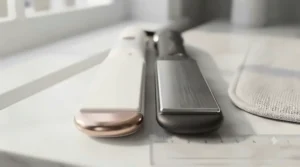
The physics behind the ceramic vs titanium debate comes down to thermal conductivity — essentially, how efficiently a material transfers heat energy. Titanium is a metal, and like most metals, it conducts heat considerably more efficiently than ceramic, which is a ceramic-oxide compound with a molecular structure that resists rapid heat transfer by design.
In practical styling terms, this shows up in two ways. First, titanium plates reach their target temperature faster from a cold start — typically around fifteen seconds versus twenty to thirty for a comparable ceramic iron. Second, and more significantly for everyday use, titanium plates recover lost heat far faster once they clamp down on a section of hair, which naturally pulls heat away from the plate surface. A ceramic plate loses more temperature on contact and takes noticeably longer to return to its set point, which is precisely why thick or coarse hair styled on ceramic often needs a second or third pass to achieve the same result titanium manages in one.
The trade-off is that this same efficient heat transfer makes titanium less forgiving. Because the plates recover heat so quickly, there’s less natural “cooling” moment between passes, meaning cumulative heat exposure on the hair shaft can climb faster than the temperature dial alone would suggest — one of the more genuinely useful, less publicised reasons titanium has a reputation for being “harsher” on hair than the numbers on the display would indicate.
Plate Material Lifespan: How Long Ceramic and Titanium Plates Actually Last
Longevity is one of the more overlooked factors in the ceramic vs titanium decision, and it’s not simply a case of “metal outlasts ceramic.” Genuine ceramic coatings, when properly maintained, typically remain fully functional for two to four years of regular use before noticeable wear affects glide and heat distribution; the coating itself is what degrades over time, usually through scratching from product build-up or careless storage, rather than through heat cycling alone.
Titanium, being a solid metal rather than a coating, generally resists surface wear for longer — nano titanium plating in particular, as used on the BaBylissPRO Nano Titanium, is specifically engineered for corrosion resistance, which can meaningfully extend usable lifespan toward the four-to-six-year mark with consistent care. However, titanium irons are typically used on thicker, more resistant hair at higher effective heat exposure, which places more mechanical stress on internal heating elements and hinges even if the plate surface itself holds up well.
| Factor | Ceramic | Titanium |
|---|---|---|
| Typical plate lifespan | 2-4 years | 4-6 years |
| Main degradation cause | Coating wear from build-up | Hinge/element stress from heavy use |
| Cost-per-year (mid-range) | Lower upfront, more frequent replacement | Higher upfront, less frequent replacement |
Interpreting this table honestly: a genuinely well-made ceramic straightener like the GHD Platinum+, backed by a three-year warranty, can outlast a poorly-maintained titanium iron despite the material’s inherent durability advantage — build quality and care habits ultimately matter more than the plate material alone when it comes to real-world lifespan.
Hair Type Compatibility: Matching Plate Material to Your Actual Hair
Beyond the broad fine-versus-thick split already covered, plate material compatibility gets more nuanced once you factor in curl pattern and processing history. Naturally straight or gently wavy hair generally does well on either material, since there’s less structural resistance to overcome — the choice here often comes down to styling frequency and budget rather than hair-type necessity.
Curly and coily hair types present a more interesting case. Reviewers consistently note that titanium’s efficient, deep heat transfer works well for breaking down stubborn curl memory in a single pass, which the Diva Pro Styling Ultra Fast Titanium and BaBylissPRO Nano Titanium are both well-suited for — but ceramic options with ionic technology, like the Revamp Progloss Touch Digital Ceramic Straightener, close much of that performance gap while remaining gentler on the scalp-adjacent sections that see the most repeated heat exposure during a full head of styling.
Chemically processed or previously bleached hair is the clearest case for ceramic across the board, regardless of natural thickness, because the hair’s protein structure has already been compromised and is more vulnerable to titanium’s aggressive heat transfer at the same displayed temperature. In these cases, a lower-heat ceramic pass, even if it takes an extra sweep through each section, is the more defensible long-term choice for hair health.
Common Mistakes When Buying Ceramic or Titanium Straighteners
The most frequent buying mistake isn’t choosing the wrong material outright — it’s assuming maximum temperature is the primary performance indicator. A straightener that reaches 230°C but distributes that heat unevenly will underperform one that tops out lower but does so consistently, which is precisely the argument for the GHD Platinum+‘s fixed 185°C approach over a higher, less controlled ceiling.
A second common error is ignoring plate width relative to hair length. Buyers with long or thick hair frequently purchase narrow, precision-focused plates because they look sleek in marketing photos, then find themselves taking twice as long to style as a wider-plated alternative would require — the BaBylissPRO Nano Titanium‘s five-inch plates exist specifically to solve this, at the cost of being genuinely unwieldy for anyone with short or fine hair.
A third mistake is buying titanium by default because it sounds more “professional,” without accounting for hair sensitivity. Titanium’s marketing often leans on its use in salons, but salons use it because stylists control heat exposure with practised precision across hundreds of clients — that same tool in inexperienced hands on fine or damaged hair can cause more harm than a gentler ceramic alternative. Finally, buyers regularly skip checking for genuine UK electrical safety compliance on unfamiliar or marketplace-only brands; unbranded imports have repeatedly appeared in official recall notices for exactly this reason, which is covered in more detail below.
Safety, Regulations and Buying Secondhand: What UK Shoppers Should Know
Heated hair styling tools are legally classed as electrical appliances in the UK and must comply with the Electrical Equipment (Safety) Regulations 2016 and the Plugs and Sockets etc. (Safety) Regulations 1994. This isn’t a bureaucratic footnote — it has real consequences, since unbranded or marketplace-only straighteners have repeatedly been subject to official safety recalls for issues including incorrectly rated plug fuses, inadequate insulation around live components, and fire risk from substandard wiring. Before buying an unfamiliar brand, particularly through third-party marketplace sellers rather than established retailers, it’s worth checking the UK government’s product recalls and alerts register for any existing safety notices.
All seven products featured in this guide are supplied by established, recognisable brands with UK three-pin plugs and standard safety certifications, which meaningfully reduces this risk compared with unbranded alternatives frequently found through unofficial marketplace listings. Regardless of brand, a handful of habits reduce genuine risk: always unplug the straightener immediately after use rather than leaving it on standby, never use any heated styling tool near water or on wet hair, and replace any unit showing a frayed cord or damaged plug rather than continuing to use it.
If buying secondhand, be aware that Amazon’s official warranty and safety assurances typically don’t extend to resold units, and that plate coatings degrade with prior use in ways that aren’t always visible on inspection — a secondhand ceramic iron with a scratched, worn coating loses much of the even-heat advantage that made ceramic worth choosing in the first place.

Frequently Asked Questions
❓ Are ceramic or titanium straighteners better for fine hair?
❓ Do titanium plates last longer than ceramic plates?
❓ What temperature should I use on ceramic vs titanium straighteners?
❓ Can I use a titanium straightener on fine hair safely?
❓ Why do titanium straighteners heat up faster than ceramic ones?
Conclusion
The ceramic vs titanium straighteners question doesn’t have a universal winner, and any guide claiming otherwise is oversimplifying genuine material science for the sake of a tidier recommendation. Ceramic plates, as seen across the Remington Ceramic Straight 230 S3500, Remington Shine Therapy S8500, Revamp Progloss Touch Digital Ceramic Straightener, and the premium GHD Platinum+, earn their reputation through gradual, even heat that suits fine, normal, or previously processed hair. Titanium, represented here by the BaByliss Straight & Curl Brilliance, Diva Pro Styling Ultra Fast Titanium, and BaBylissPRO Nano Titanium, wins on raw speed and heat recovery, making it the more time-efficient choice for thick, coarse, or curly hair that resists lower temperatures.
What actually determines the right pick isn’t brand prestige or headline temperature figures — it’s an honest read of your own hair’s resistance, your styling frequency, and how much time you’re realistically willing to spend each morning. Buy for your hair as it actually behaves, not for the material that sounds more impressive on the box, and any of these seven straighteners will earn its place in your routine.
Recommended for You
- Ceramic Straighteners for Beginners: 7 Best Picks for 2026
- Hair Straighteners for Thick Hair: 7 Winning Picks (2026)
- Flat Iron vs Hair Straightener: 7 Best UK Picks for 2026
Disclaimer: This article contains affiliate links. As an Amazon Associate, I earn from qualifying purchases. If you purchase products through these links, we may earn a small commission at no additional cost to you.
✨ Found this helpful? Share it with your friends! 💬🤗
