
In This Article
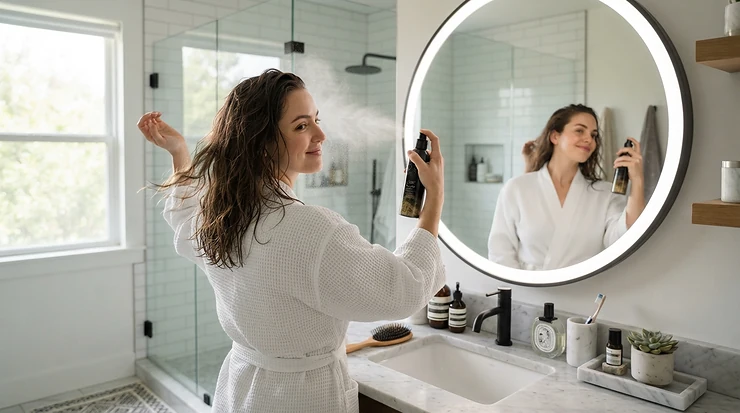
Picture this. You blow-dry, straighten, admire yourself for roughly four seconds, and then notice your hair looks like it’s been dusted with chalk. Flat. Rough. Oddly stubborn. If you live in London, Kent, Essex, Cambridgeshire or pretty much anywhere on a chalk or limestone belt, your kettle has probably been warning you about this for years.

Here’s the honest bit most product roundups skip. No spray on a shelf can reverse a mineral film on its own. A good heat protection spray for hard water hair does a different job: it stops your tools from cooking a surface that’s already struggling, and it avoids adding more residue on top of the minerals. The deposits themselves come off in the shower, with a chelating or clarifying wash.
So this guide does two things. First, it ranks seven real, widely available UK sprays on how well they suit hair that lives with limescale. Second, it explains the routine around them, because that’s where the results come from. Along the way we’ll cover mineral build-up, dull brittle strands, chelating ingredients, and what to do about limescale on your hair.
A quick note on method: I haven’t tested these products personally. Everything below comes from published specifications, UK editorial reviews and the general pattern of customer feedback, and I’ll say plainly where something couldn’t be verified.
Quick Comparison Table: Which Spray Suits Which Hard Water Problem?
| Product | Format | Typical price range | Standout trait | Best For |
|---|---|---|---|---|
| TRESemmé Care & Protect Heat Defence Spray | Spray | Under £8 | Heat-activated complex | Budget buyers, daily blow-drying |
| Aussie SOS Heat Protector Saviour | Leave-in spray | Under £8 | Light feel | Fine hair that goes flat quickly |
| got2b Guardian Angel | Spray | Under £8 | Silicone-free, up to 220°C | Anyone worried about layering residue |
| Lee Stafford Coco Loco & Agave | Mist | Under £8 | Amazon bestseller reputation | Cheap, cheerful everyday mist |
| ghd Bodyguard | Spray | Roughly £17-£22 | Made for straightener users | Frequent straightening |
| Davines Melu Shield | Spray | Roughly £25-£32 | Anti-damage positioning | Long, fragile, damaged hair |
| Moroccanoil Perfect Defense | Aerosol spray | Roughly £20-£30 | Argan oil and vitamins | Dry, frizzy hair needing nourishment |
Read the table as a map, not a podium. The budget trio (TRESemmé Care & Protect Heat Defence Spray, Aussie SOS Heat Protector Saviour and got2b Guardian Angel) all cost less than a takeaway coffee and a pastry, which matters because hard water households tend to need a fresh bottle often. If you straighten several times a week, ghd Bodyguard earns its premium by being designed around that exact tool. Fragile ends point towards Davines Melu Shield, while Moroccanoil Perfect Defense is the richer, more conditioning option. Prices are indicative only, so check current price before buying.
💬 Just one click — help others make better buying decisions too!😊
What Is Heat Protection Spray for Hard Water Hair?
A heat protection spray for hard water hair is a styling product applied before blow-drying or hot tools that coats each strand with a thin, heat-tolerant film, slowing moisture loss and surface damage. For hard water, the best versions rinse off cleanly and don’t build up, so they don’t stack residue on top of mineral deposits.
Why does that distinction matter? Hard water carries dissolved calcium and magnesium picked up as rain passes through chalk and limestone. Those ions leave a faint film on hair with every wash. Heavy, wax-rich or silicone-heavy sprays can cling to that film, and the result is the dull, coated, slightly crunchy feel many people blame on “bad hair days”.
Think of it as painting a wall. Spraying a protectant onto hair that’s already mineral-coated is like painting over dust. It works for a bit, then it flakes. The sensible order is cleanse, then protect.
Top 7 Heat Protection Spray Picks for Hard Water Hair: Expert Analysis
Two ground rules before the list. First, none of these sprays is marketed as a chelating treatment, and I’d be suspicious of any that claimed to be. Second, I’ve ranked them on how well their stated formulation and format suit hard water habits: light application, easy rinse-out, sensible price for frequent replacement.
1. TRESemmé Care & Protect Heat Defence Spray — best budget workhorse
TRESemmé Care & Protect Heat Defence Spray is the sensible starting point, the one you buy while you’re still working out whether hard water is really your problem. UK editorial roundups have repeatedly named it the best budget heat protection spray, and it carries a heat-activated complex designed to work as your dryer or straighteners warm up.
That matters in a hard water home for a practical reason: a cheap bottle means you’ll actually use enough of it, evenly, every time. Underdosing is the quiet saboteur of heat protection. On paper, the spray format also means you can mist from a distance, which keeps application light and helps avoid the heavy pooling that traps minerals.
Who is it for? Anyone blow-drying most days who wants dependable cover without paying salon prices. Who should look elsewhere? Very dry, brittle hair may want something richer.
Review sentiment is broadly positive on value and availability, though I couldn’t verify a large pool of Amazon UK reviews, so treat that as a general pattern rather than a statistic.
Pros:
- ✅ Very low price per application
- ✅ Heat-activated formula suits blow-drying and straightening
- ✅ Widely stocked, easy to repurchase
Cons:
- ❌ Less nourishing on very dry ends
- ❌ Not designed with mineral-heavy hair in mind
Price range: under £8. Value verdict: unbeatable as an entry point.
2. Aussie SOS Heat Protector Saviour — best for fine hair that flops
Fine hair shows mineral build-up first, because there’s less strand to hide it. Aussie SOS Heat Protector Saviour is a leave-in spray that Expert Reviews picked as its best option for fine hair, which is a useful clue: light formulas don’t weigh strands down, and light formulas are exactly what a hard water scalp-and-strand situation needs.
The scent profile leans fruity, built around peach, manuka, macadamia nut oil and avocado. In practice, that means a conditioning edge without the heavy oiliness of some argan-based rivals. Here’s the thing to watch: leave-in conditioning ingredients can build up if you stack them nightly, so on hard water, use it lightly and rotate in a clarifying wash.
It suits fine to medium hair, people who air-dry partly before heat, and anyone who dislikes stiff, crunchy finishes. It’s less ideal for thick, coarse hair that needs more slip.
Review sentiment skews towards “easy to use and smells good”, particularly among people who simply towel-dry and spray, though again this is a general theme rather than a verified rating.
Pros:
- ✅ Light feel that suits fine hair
- ✅ Doubles as a leave-in conditioner
- ✅ Very affordable
Cons:
- ❌ Conditioning ingredients can layer with overuse
- ❌ May be too light for coarse hair
Price range: under £8. Value verdict: superb for the money, as long as you clarify regularly.
3. got2b Guardian Angel — silicone-free peace of mind
If your main fear is residue, got2b Guardian Angel is worth a look. The product listing describes it as silicone-free and offering up to 220°C of protection from blow dryers, curling tongs and straighteners, in a 200ml bottle.
Why does silicone-free matter here? Silicones form a smooth, water-resistant coat. Brilliant for shine, but on hair already wearing a mineral film, repeated layers can make strands feel coated and heavy. A silicone-free formula won’t solve limescale, but it removes one source of stacking. Reasonably, it suits people who wash frequently, style daily and want predictable rinse-out.
The trade-off is finish. Silicone-based competitors often give more dramatic gloss and slip, so expect a more natural look. 220°C also sits comfortably above the sensible styling temperature for most hair, as lower settings are kinder anyway.
I couldn’t verify a meaningful sample of customer reviews for this specific bottle, so I’m leaving sentiment out rather than guessing.
Pros:
- ✅ Silicone-free formulation
- ✅ Up to 220°C protection claimed
- ✅ Generous 200ml bottle for the price
Cons:
- ❌ Less glossy than silicone-rich rivals
- ❌ Limited independent testing available
Price range: under £8. Value verdict: a smart pick for residue-wary shoppers.
4. Lee Stafford Coco Loco & Agave — the cheerful bestseller
Lee Stafford Coco Loco & Agave earned a reputation as an Amazon bestseller in the heat protection category, and a UK lifestyle roundup flagged it at an extremely low price. Popularity isn’t proof of performance, but it does tell you something: thousands of people repurchased it, which usually means it behaves itself.
It’s a mist rather than a heavy cream, which is helpful for hard water hair. Mists distribute evenly with less product, reducing the odds of build-up at the roots and mid-lengths. The coconut and agave theme suggests a light conditioning layer, though the real test is how it feels after repeated use between clarifying washes.
Consider it for students, anyone with a large household using one bottle, or people who want a back-up spray in the gym bag. Skip it if you want a specialist, damage-repair formulation.
Review sentiment (bestseller status aside) is hard to quantify from what I could verify, so check recent buyer comments on the listing before committing.
Pros:
- ✅ Very low cost per use
- ✅ Light mist format
- ✅ Strong everyday-use reputation
Cons:
- ❌ Not a repair-focused formula
- ❌ Bestseller rank can change at any time
Price range: under £8. Value verdict: a low-risk everyday option.
5. ghd Bodyguard — made for serious straightener use
ghd Bodyguard comes from a brand that lives and dies by straightening, and Expert Reviews rated it best for hair straightening. That focus shows in the intent: the spray is built to sit between your hair and a hot plate, which is where heat damage is most concentrated.
For hard water hair, this is the product to consider if you straighten several times a week. Hard water roughens the cuticle, and a rough cuticle is more vulnerable to the friction and heat of flat irons. Protection matters more, not less, in that scenario. A premium spray also tends to give a more refined mist, which helps with even coverage.
Be realistic about its limits. It protects the hair you’ve got; it doesn’t remove calcium. Pair it with a monthly chelating wash and it makes more sense.
Review sentiment from editorial and reader comments is warm, with one UK roundup highlighting a delighted buyer who finally gave it a go after hearing good things.
Pros:
- ✅ Designed around straightener use
- ✅ Fine, even mist for consistent coverage
- ✅ Respected professional-grade brand
Cons:
- ❌ Costs several times more than budget sprays
- ❌ Doesn’t address mineral deposits
Price range: roughly £17-£22. Value verdict: worth it if you straighten often.
6. Davines Melu Shield — for long, fragile, damaged ends
Davines Melu Shield was named best for damaged hair by Expert Reviews, and it sits in the upper-middle of the price bracket. The Melu range is positioned around anti-breakage care for long, fragile lengths, which maps neatly onto the dull brittle strands that mineral-heavy water can leave behind.
Why would that matter? Brittle ends are where heat damage escalates quickest. If your hair is already splitting, a bargain spray may not offer the cushioning those ends need. A more treatment-led protectant helps limit further snapping while the chelating wash does the clean-up work.
It suits shoulder-length to long hair, heavily processed hair, and anyone who wants one premium product rather than a cupboard of cheap ones. If your hair is short, fine and healthy, you’re probably overspending.
I couldn’t verify enough independent customer reviews to summarise sentiment confidently, so rely on the editorial verdict above and check recent buyer comments.
Pros:
- ✅ Positioned for damaged, fragile hair
- ✅ Editorially recommended for damage
- ✅ Premium formulation for long lengths
Cons:
- ❌ Pricey for daily bulk use
- ❌ Overkill for healthy short hair
Price range: roughly £25-£32. Value verdict: justified for damaged hair only.
7. Moroccanoil Perfect Defense — richest conditioning option
Moroccanoil Perfect Defense is a leave-in heat protectant built around argan oil and vitamins, aimed at frizz and dryness, and it comes as an aerosol according to one UK product comparison. That aerosol delivery produces a very fine, fast mist.
For hard water hair, this is the one I’d approach with the most care. Oil-rich formulas are brilliant on dry, frizzy hair, but oils can layer if you never clarify. Used sparingly, with a monthly chelating or clarifying wash, it’s a lovely finishing step. Used heavily on already coated hair, it may feel greasy by day two.
Choose it if your hair is thick, curly or coarse and craves moisture. Avoid it if you have fine, flat-prone hair.
Sentiment is generally positive on smoothness and shine in the sources I found, but I couldn’t confirm a sizeable verified review sample.
Pros:
- ✅ Rich, smoothing argan oil conditioning
- ✅ Very fine aerosol mist
- ✅ Great for dry, frizzy textures
Cons:
- ❌ Can feel heavy on fine hair
- ❌ Premium price for an aerosol
Price range: roughly £20-£30. Value verdict: lovely for dry hair, if used lightly.
Top 7 at a Glance: Spec Comparison
| Product | Format | Price range | Best For | Hard water note |
|---|---|---|---|---|
| TRESemmé Care & Protect Heat Defence Spray | Spray | Under £8 | Daily budget use | Cheap enough to apply generously |
| Aussie SOS Heat Protector Saviour | Leave-in spray | Under £8 | Fine hair | Light, but clarify regularly |
| got2b Guardian Angel | Spray | Under £8 | Residue-wary users | Silicone-free, up to 220°C |
| Lee Stafford Coco Loco & Agave | Mist | Under £8 | Everyday mist | Light distribution |
| ghd Bodyguard | Spray | £17-£22 | Straightening | Protects a roughened cuticle |
| Davines Melu Shield | Spray | £25-£32 | Damaged ends | Treatment-led protection |
| Moroccanoil Perfect Defense | Aerosol | £20-£30 | Dry, frizzy hair | Oil-rich, so clarify monthly |
The pattern here is simple: spend more as your hair becomes more damaged or more heavily heat-styled, not because it’s hard-water-specific. For fine hair, Aussie SOS Heat Protector Saviour and got2b Guardian Angel keep things light, while Moroccanoil Perfect Defense belongs on thicker, thirstier hair. Prices change often, so check current price on the listing.
Mineral Build-Up: What Hard Water Really Does to Your Hair
Mineral build-up is the quiet part of the story. Calcium and magnesium ions in the water adhere to the hair surface, and washing in hard water also makes soap and shampoo lather less efficiently, so more residue gets left behind. Over weeks, strands feel rougher, products sit on top rather than sinking in, and colour can look muted.
The science, though, is more nuanced than the marketing. One study discussed in dermatology literature found noticeably more magnesium on hair exposed to hard water for three weeks, even without visible surface cracks. Meanwhile, an earlier trichology study found no significant drop in tensile strength or elasticity after short-term exposure. Other research cited in public health blogs points the other way, so the honest summary is that deposits are well documented, while long-term structural weakening remains debated.
What does that mean for you? Treat mineral build-up as a surface problem first. It changes how hair feels, reflects light and accepts products. That’s exactly why the order of operations matters: remove deposits, then protect against heat, then condition.
Iron deserves a mention too. Where water carries iron, it can accelerate colour oxidation, which is another reason people with coloured hair notice hard water sooner than everyone else.
Dull Brittle Strands: Is It Hard Water, Heat, or Both?
Dull brittle strands are the symptom that sends people shopping, and they have multiple causes. Heat styling dehydrates the cortex. Bleaching and colouring lift the cuticle. Hard water coats it. Most hair in hard water areas is suffering from a combination.
Here’s a rough diagnostic. If your hair feels better after a holiday somewhere with softer water, minerals are likely a factor. If your ends snap even when freshly clarified, heat or chemical damage is probably the main culprit. And if your colour fades faster than your colourist expects, water chemistry plus heat may both be involved.
Why does that matter for spray choice? Because brittle hair needs cushioning, while mineral-coated hair needs clearing. A spray can handle the first job, but not the second. That’s where a product like Davines Melu Shield makes sense for damaged ends, and where a light, affordable option like TRESemmé Care & Protect Heat Defence Spray suffices when the real fix is a better washing routine.
A practical test: after a clarifying wash, run a damp strand between your fingers. Smooth glide suggests deposits were the issue. Persistent roughness and tiny snaps suggest structural damage that heat protection can only slow, not reverse.
Chelating Ingredients Explained (And Why They Don’t Belong in a Spray)
Chelating ingredients are molecules that grab metal ions and hold them so they can be rinsed away. The best known is EDTA, and you’ll also see citric acid or other plant-derived alternatives. In shampoo, they bind calcium, magnesium and sometimes iron or copper, lifting them from the hair.
Cosmetic chemist Ron Robinson has been quoted advising shoppers to look for chelating shampoos or the ingredient EDTA, which binds minerals so they can be rinsed away. Notice the key phrase: rinsed away. That’s the whole mechanism.
Now apply that to a spray. A leave-in product stays on the hair, so it never gets that contact-then-rinse cycle. One UK roundup of leave-in conditioners went as far as saying that no leave-in is hard water safe and that concentration and contact time are what matter, which a leave-in lacks. Be wary of a spray label shouting about chelating ingredients; even if they’re present, they probably can’t do the job.
So where should chelating ingredients live in your routine? In a clarifying or chelating shampoo used roughly every two to four weeks, followed by a proper conditioner. Then your heat spray goes onto clean, mineral-free hair, and it works far better.
Clarifying Heat Protectant Spray for Hard Water Areas: Does Such a Thing Exist?
Short answer: not really, and that’s okay. A genuinely clarifying heat protectant spray for hard water areas would need to strip deposits and leave a protective film simultaneously, which are opposite jobs. Products that blur the line usually do one badly.
What does exist is a clarifying system: a chelating shampoo, a clean rinse, a light conditioner, and a lightweight protectant. Think of the spray as the final layer, not the cleaner.
When shopping for a clarifying heat protectant spray for hard water areas, translate the marketing into attributes you can actually check. Look for a fine mist, a formula that mentions rinse-out cleanly or being lightweight, no waxy or heavy-oil emphasis, and ideally a silicone-free or lower-silicone profile if you wash infrequently. got2b Guardian Angel fits the silicone-free brief, while Aussie SOS Heat Protector Saviour and Lee Stafford Coco Loco & Agave are light enough to rotate with clarifying washes.
If a brand does claim clarifying powers in a leave-in spray, treat it as a mild perk, not a replacement for a monthly chelating wash. Your hair, and your wallet, will thank you for the realism.
Heat Spray for Limescale Build-Up Hair: How to Layer Your Routine
A heat spray for limescale build-up hair is really a layering question. Limescale itself forms when hard water is heated and calcium carbonate deposits out, which is why your kettle suffers. Your hair doesn’t grow limescale in the same way, but the mineral film it picks up behaves similarly: it sticks, it dulls, and it resists products.
Here’s a layering order that respects that.
- Cleanse with a chelating or clarifying shampoo (every two to four weeks).
- Condition properly, focusing on mid-lengths and ends.
- Towel-dry gently and detangle with a wide-tooth comb.
- Mist the heat spray from about 20cm away, working through evenly.
- Dry or style at the lowest effective temperature.
Why 20cm? A distance mist spreads product thinly, which reduces pooling and the risk of residue stacking. Many brands recommend similar distances.
For a heat spray for limescale build-up hair, the lighter sprays in this guide shine: TRESemmé Care & Protect Heat Defence Spray, got2b Guardian Angel and Lee Stafford Coco Loco & Agave. Save heavier, oil-rich options like Moroccanoil Perfect Defense for days when your hair genuinely feels dry, not for every single styling session.
How to Choose Heat Protection Spray for Hard Water Hair
Choosing well comes down to five or six questions. UK testing sites such as Expert Reviews’ heat protection spray guide group their picks by hair type and budget, which is a sensible approach to copy.
- Match the weight to your hair. Fine hair needs light, leave-in sprays; thick or coarse hair can handle richer formulas. Heavy products on fine hair look flat quickly, especially when minerals add their own dullness.
- Check the heat rating. Where a brand states a maximum temperature, such as 220°C on got2b Guardian Angel, use it as a ceiling, not a target. Lower styling temperatures are kinder.
- Think about residue. If you wash infrequently, silicone-free or lightweight formulas reduce stacking.
- Consider your styling frequency. Daily straighteners justify a product like ghd Bodyguard; weekly blow-drying doesn’t.
- Budget for replacement. Hard water households often go through product faster because they re-apply more. Cheap, reliable options matter.
- Plan the cleanse. Whatever spray you choose, pair it with a chelating wash. That’s the step that makes it work.
The common thread: a spray is one part of a system. Pick it to suit your hair, then build the cleansing routine around it.
Practical Usage Guide: A Four-Week Hard Water Heat-Styling Reset
This is the transformation bit, and it’s where you’ll get more value than any product page can offer. Before you start, find out how hard your water is. Many suppliers publish zone data, and resources such as Tap Water Data’s UK water hardness map list supply-zone readings in mg/L of calcium carbonate, with very hard areas well above 300.
Week 1: Reset. Use a chelating shampoo once, follow with a deep conditioner, and skip heat for a couple of days if you can. Notice how your hair feels afterwards: lighter, smoother, more responsive.
Week 2: Protect. Start every heat session with your chosen spray, applied from 20cm onto damp or towel-dried hair, depending on the label. Keep styling temperatures moderate.
Week 3: Simplify. Drop anything unnecessary, such as multiple leave-ins and heavy oils. Less layering means less to build up.
Week 4: Reassess. Wash with the chelating shampoo again if hair feels coated, otherwise extend the interval.
Common first-month mistakes: spraying too close, overapplying, skipping conditioner after chelating (it can be drying), and using the same heavy product every day. A shower filter may help reduce future exposure, though it won’t fix existing deposits.

Real-World Scenarios: Three Hard Water Households
Let’s make this concrete with three profiles. These are illustrative examples, not case studies of real people.
Scenario 1: The commuter in Kent. She blow-dries five mornings a week, has fine, shoulder-length hair and a tight budget. Kent has been reported among the hardest-water counties in the UK. Best match: Aussie SOS Heat Protector Saviour or TRESemmé Care & Protect Heat Defence Spray, with a chelating wash every three weeks. Low cost, light finish, regular clearing.
Scenario 2: The straightener devotee in London. Thick, naturally wavy hair, straightened four times a week, coloured every eight weeks. London tap water has been measured well above the 200ppm “hard” threshold across its Tube stations. Best match: ghd Bodyguard, with a chelating wash before each colour appointment and an iron-aware approach to colour care.
Scenario 3: The long-haired student in Cambridgeshire. Long, bleached, brittle ends, styled with tongs a couple of times a week, student budget stretched. Best match: Davines Melu Shield if finances allow, otherwise got2b Guardian Angel as a lighter, cheaper fallback.
In each case, frequency of heat use, hair condition and budget drive the choice, not the postcode alone.
Problem → Solution Guide: Five Hard Water Heat-Styling Headaches
Problem 1: Hair feels coated and flat even after washing. Solution: a chelating shampoo, then a lighter spray such as Aussie SOS Heat Protector Saviour.
Problem 2: Hair looks dull straight out of the straighteners. Solution: check for deposits first. Clean hair reflects light better. Then use a dedicated straightener spray like ghd Bodyguard.
Problem 3: Colour fades or turns brassy quickly. Solution: hard water minerals, particularly iron, can speed colour oxidation, so chelate before colour appointments and ask your colourist for advice.
Problem 4: Spray leaves hair crunchy. Solution: you’re likely using too much or spraying too close. Mist from distance, use fewer sprays, and try a lighter formula like got2b Guardian Angel.
Problem 5: Ends snap despite heat protection. Solution: lower temperatures, trim damaged ends, and consider Davines Melu Shield for treatment-led cushioning.
Notice that four of the five solutions start with cleansing, not spraying. That’s the single most useful takeaway of this whole guide.
Heat Protection Spray vs Shower Filters and Water Softeners
You have three ways to fight hard water on hair, and they do different jobs.
| Approach | What it does | Typical cost | Limitations | Best For |
|---|---|---|---|---|
| Heat spray (e.g. TRESemmé Care & Protect Heat Defence Spray) | Reduces heat damage | Under £8 per bottle | Doesn’t remove minerals | Anyone who heat styles |
| Chelating shampoo | Removes existing deposits | Varies by brand | Can dry hair if overused | Heavily mineral-coated hair |
| Shower filter | Reduces some exposure | Moderate, one-off | Not a cure for existing build-up | Ongoing prevention |
| Whole-home water softener | Removes hardness at source | High installation cost | Expensive, needs plumbing | Homeowners in very hard areas |
The takeaway is that these tools are complements, not competitors. A softener protects your hair, kettle and boiler, but it’s a big investment. A shower filter is a cheaper middle ground, though results vary. The sprays in this guide, from got2b Guardian Angel to ghd Bodyguard, handle the heat-damage side of the equation, while a chelating wash handles the mineral side. If you can only afford one thing, start with the chelating wash and a budget spray.
Features That Actually Matter (And Those That Don’t)
Marketing around heat protectants gets loud. Here’s what deserves your attention.
Matters: a clear heat rating or usage instruction, a fine mist, suitability for your hair type, and a formulation that suits your washing frequency. Rinse-out behaviour counts for more in hard water than almost anything else.
Doesn’t matter much: exotic fragrance, gold-leaf packaging, and a long list of botanical extracts at tiny concentrations. A pretty bottle of Moroccanoil Perfect Defense is lovely, but its value comes from the argan-oil conditioning and fine delivery, not the label.
Be sceptical of: claims that a leave-in removes minerals, miracle “repair” language, and temperature claims without any detail. A leave-in’s role is protection. Cleansing belongs elsewhere.
Worth checking: whether the formula suits daily use or occasional use. Rich oils, as in Moroccanoil Perfect Defense, can be wonderful twice a week and too much every day on fine hair. By contrast, light mists like Lee Stafford Coco Loco & Agave and TRESemmé Care & Protect Heat Defence Spray tolerate frequent use better.
Finally, don’t ignore your tools. Ceramic plates, adjustable temperature settings and a lower heat setting do more for your hair than any bottle.
Long-Term Cost & Value: What You’ll Really Spend
Hard water hair care isn’t expensive, but it adds up if you buy badly. A budget spray costs under £8 and might last several weeks of daily use. A premium bottle in the £17-£32 range may last longer if you apply lightly, though not always.
| Option | Typical outlay | Likely replacement | Value verdict |
|---|---|---|---|
| TRESemmé Care & Protect Heat Defence Spray | Under £8 | Every 1-2 months | Best cost per use |
| got2b Guardian Angel | Under £8 | Every 1-2 months | Strong residue-conscious value |
| ghd Bodyguard | £17-£22 | Every 2-3 months | Good for heavy straightening |
| Davines Melu Shield | £25-£32 | Every 2-4 months | Worth it for damaged hair |
| Chelating shampoo | Varies | Used every 2-4 weeks | Highest impact per pound |
Replacement times are rough estimates based on typical use, not manufacturer claims. The surprise is that the chelating shampoo, not the spray, delivers the biggest improvement per pound. Combine it with a sensible spray like Aussie SOS Heat Protector Saviour and you’ve covered most of the problem for the price of a decent lunch. Splurge on Davines Melu Shield only when your hair’s condition justifies it.

FAQ
❓ Can I use heat protection spray for hard water hair every day?
❓ Does a shower filter replace heat protection spray?
❓ Which budget spray is best for hard water areas?
❓ Should I clarify hair before or after using heat spray?
❓ How often should I use a chelating shampoo in a hard water area?
Conclusion
Choosing a heat protection spray for hard water hair isn’t about finding a miracle bottle. It’s about building the right order of operations: cleanse minerals out with a chelating wash, condition, then protect with a light, well-chosen spray. Do that, and even the cheapest bottle on this list performs better.
If you want to start simple, TRESemmé Care & Protect Heat Defence Spray and Aussie SOS Heat Protector Saviour are sensible, low-cost picks. Residue-conscious shoppers should consider got2b Guardian Angel, while Lee Stafford Coco Loco & Agave is a friendly everyday mist. For heavier styling and damage, step up to ghd Bodyguard, Davines Melu Shield or the richer Moroccanoil Perfect Defense.
Remember, hardness varies hugely across the UK. Research from water-industry sources such as Aspect’s UK hard water breakdown suggests the South East’s chalk and limestone geology produces some of the hardest water in the country, so your starting point may differ from a friend’s in Edinburgh.
✨ Ready to give your hair a fresh start?
🔍 Pick the spray that suits your hair, pair it with a chelating wash, and click through to check current pricing and availability. Your strands, and your straighteners, will be glad you did!
Recommended for You
- Travel Size Heat Protection Spray For Curling Tongs: 7 Best (2026)
- Steam Rollers For Volume: 7 Brilliant UK Picks (2026)
- Steam Rollers For Fine Hair: 7 Best Gentle Picks (2026)
Disclaimer: This article contains affiliate links. As an Amazon Associate, I earn from qualifying purchases. If you purchase products through these links, we may earn a small commission at no additional cost to you.
✨ Found this helpful? Share it with your friends! 💬🤗
