
In This Article
If you’ve got dry hair in Britain, you’re already fighting an uphill battle. Between the relentless damp that seeps into every corner of our homes and the central heating that turns our flats into miniature deserts come October, maintaining proper hair moisture feels rather like trying to fill a bucket with a hole in it. Most hair dryers don’t help—in fact, they’re often the culprit behind that straw-like texture you’re desperately trying to fix with serums and masks.
Here’s what most people don’t realise: a hair dryer for dry hair isn’t simply a standard dryer set to a lower temperature. The best models use moisture-retaining technology—ionic systems that seal the hair cuticle, ceramic heating elements that distribute warmth evenly without creating damaging hot spots, and infrared capabilities that dry from within whilst preserving surface hydration. In 2026, the technology available on Amazon.co.uk has evolved dramatically beyond the basic dryers gathering dust under bathroom sinks across the UK.
I’ve spent the past month researching and analysing models specifically engineered to tackle dry, moisture-deprived hair. This isn’t about finding the most expensive dryer or the one with the flashiest attachments. It’s about identifying which technologies genuinely prevent further dehydration, which price points offer authentic value for British budgets, and which models UK buyers with dry hair consistently praise in real-world conditions—including our perpetually damp autumns and bone-dry heated winters.
Whether you’re battling chemically processed strands, naturally coarse texture, or simply the cumulative effects of years spent with the wrong tools, there’s a dryer on this list engineered to stop making things worse—and perhaps even help you reclaim some of that lost shine and softness.
Quick Comparison: Top Hair Dryers for Dry Hair at a Glance
| Model | Key Technology | Price Range | Best For | Rating |
|---|---|---|---|---|
| Dyson Supersonic Nural | Intelligent heat control, scalp protect | £350-£400 | Premium moisture protection | 4.6/5 |
| ghd Helios | Aeroprecis ionic, precision airflow | £140-£160 | Everyday hydration balance | 4.7/5 |
| BaByliss Hydro-Fusion | Dual ionic plasma technology | £55-£75 | Budget moisture retention | 4.6/5 |
| Remington Hydraluxe AC8901 | Micro-conditioner release system | £60-£85 | Active moisture replacement | 4.5/5 |
| Philips DryCare Prestige HP8280 | Infrared MoistureProtect sensor | £90-£120 | Temperature-controlled hydration | 4.4/5 |
| Panasonic Nanoe EH-NA7M | Moisture-rich nanoe particles | £150-£180 | Deep hydration penetration | 4.5/5 |
| BaByliss Air Power Pro | Digital motor, lightweight ionic | £80-£110 | Fast drying with moisture seal | 4.5/5 |
💬 Just one click — help others make better buying decisions too!😊
Top 7 Hair Dryers for Dry Hair: Expert Analysis
1. Dyson Supersonic Nural – Intelligent Moisture Management
The Dyson Supersonic Nural represents the current pinnacle of intelligent heat control technology available on Amazon.co.uk. What separates this model from standard dryers is the Scalp Protect mode—infrared sensors that continuously monitor proximity to your scalp and automatically reduce heat before damage occurs. For dry hair, this matters enormously because overheating at the roots is where most moisture loss begins during the drying process.
The 1,600W digital motor generates 200 km/hr airflow without relying on excessive heat, meaning your hair dries through velocity rather than temperature. This is particularly effective in British homes where you might be drying hair in a chilly bathroom—the focused airflow compensates for lower ambient temperatures without cranking up damaging heat. The attachment learning system remembers your preferred settings for each magnetic attachment, eliminating the guesswork that often leads to accidental overdrying.
UK reviewers with chemically treated and naturally dry hair consistently note reduced brittleness after switching to this model. One Edinburgh buyer mentioned noticing visibly improved moisture retention within the first fortnight of use. The compact design suits smaller British bathrooms, and the 2.6m cable reaches comfortably even in awkwardly configured spaces.
Pros:
✅ Automatic heat adjustment prevents moisture loss at roots
✅ High-velocity airflow reduces heat exposure time
✅ Suitable for all hair types with intelligent customisation
Cons:
❌ Premium price point around £350-£400
❌ Heavier than some competitors at 660g
The Supersonic Nural sits in the mid-£300s to low-£400s range—a significant investment, but one that genuinely delivers on its moisture-protection claims for daily users.
2. ghd Helios – Professional Ionic Moisture Sealing
The ghd Helios has held its position as a British favourite for good reason. The Aeroprecis technology focuses airflow precisely where you direct it, which sounds like marketing speak until you realise what it means for dry hair: no wasted heat dissipating into surrounding air, no need to repeatedly pass over the same section, and consequently less cumulative heat exposure.
The 2,100W motor paired with advanced ionic conditioning creates what ghd calls a moisture-locking effect—negative ions seal the hair cuticle as you dry, trapping natural oils and moisture inside rather than blasting them away with unfocused heat. In practical terms, this translates to hair that feels noticeably softer immediately after drying, without the crunchy texture many dryers leave behind. Which? UK’s independent testing consistently ranks the ghd Helios amongst the best performers for even heat distribution and frizz control.
What most UK buyers overlook about this model is the balanced weight distribution. At extended drying sessions—and if you’ve got thick, dry hair you know these can stretch to 15-20 minutes—the ergonomic design prevents the arm fatigue that makes you rush through the final sections, inevitably overdrying them. The 3m cable is genuinely long enough to move freely even in larger British bedrooms where the mirror and socket sit at opposite ends.
Pros:
✅ Focused airflow reduces total heat exposure
✅ Lightweight design for extended drying sessions
✅ Consistent moisture-sealing ionic performance
Cons:
❌ Single nozzle attachment may require separate diffuser purchase
❌ No digital temperature display
Available in the £140-£160 range, the Helios represents excellent value for UK households seeking professional moisture protection without premium pricing.
3. BaByliss Hydro-Fusion Anti-Frizz 2100 – Budget Moisture Champion
The BaByliss Hydro-Fusion Anti-Frizz 2100 delivers something genuinely unexpected at its price point: Advanced Plasma Technology that combines both positive and negative ions for moisture balance. Whilst most budget dryers simply blast negatively charged ions, this dual-ionic system actively hydrates dry hair rather than merely preventing additional moisture loss.
The 2,100W motor provides powerful airflow without excessive heat, and the lightweight construction—something multiple UK reviewers specifically mention—makes it surprisingly pleasant to use for extended periods. For families with multiple dry-haired members sharing one bathroom, this matters more than specification sheets suggest. The large plasma flow diffuser enhances and defines natural texture whilst sealing in moisture, particularly effective for UK buyers with naturally wavy or curly dry hair.
Birmingham buyers with extremely frizzy hair report that whilst the Hydro-Fusion doesn’t completely eliminate the need for styling products, it reduces frizz noticeably enough to halve product usage. After 15 years of heavy-duty use, one reviewer’s previous BaByliss finally gave up—testament to the brand’s build quality for British conditions.
Pros:
✅ Dual-ionic plasma technology at budget pricing
✅ Lightweight despite powerful motor
✅ Excellent diffuser for curly dry hair
Cons:
❌ Control switches positioned awkwardly during use
❌ Slightly heavier side for some users
The Hydro-Fusion sits comfortably in the £55-£75 range, exceptional value for genuine moisture-balancing technology.
4. Remington Hydraluxe AC8901 – Active Moisture Replacement
The Remington Hydraluxe AC8901 takes a genuinely different approach to the dry hair problem: instead of simply preventing moisture loss, it actively replaces moisture during drying. The Moisture Lock Conditioning Technology releases micro-conditioners onto hair strands as you dry, transferring microscopic hydrating particles that compensate for the moisture being evaporated.
The Hydracare temperature setting—the middle position on the heat switch, check the instructions—operates at a carefully calibrated temperature that removes water without stripping internal hydration. UK buyers with long, fine but voluminous dry hair report this function smooths their hair without the tedious process of sectioning and round-brush styling. The salon-quality AC motor provides professional power whilst the 90% increase in ions versus standard Remington dryers ensures thorough cuticle sealing.
What the spec sheet won’t tell you: this dryer performs remarkably well in the damp British climate. Autumn and winter drying, when bathroom humidity fights against your efforts, becomes noticeably more efficient. The five-year manufacturer guarantee (plus one extra year with online registration) demonstrates Remington’s confidence in long-term performance.
Pros:
✅ Micro-conditioners actively replace lost moisture
✅ Hydracare setting prevents heat damage
✅ Extended warranty coverage for UK buyers
Cons:
❌ Heavier than some competitors
❌ Some units arrived without promised storage pouch
Priced around £60-£85, the Hydraluxe offers professional moisture-replacement technology at mid-range pricing.
5. Philips DryCare Prestige HP8280 – Infrared Intelligence
The Philips DryCare Prestige HP8280 employs genuinely innovative infrared technology that continuously monitors hair temperature and automatically adjusts output before moisture-damaging heat levels are reached. This MoistureProtect sensor represents a fundamentally different approach from traditional thermostats—rather than maintaining a set temperature, it responds dynamically to your hair’s actual condition during drying.
The 2,300W professional power creates forceful airflow through ThermoProtect technology, which delivers strong but low-temperature drying. For dry hair, this combination proves ideal: rapid moisture removal without the searing heat that exacerbates dehydration. The ionisation function prevents static electricity and frizz, producing silky, shiny results even on hair that typically resembles wire wool after standard drying.
Six blower and temperature settings provide full control for precise styling, and the volume diffuser plus narrow styling nozzle accommodate both curly and straight dry hair textures. UK buyers appreciate the robust build quality and consistent performance even after years of daily use in damp British bathrooms where lesser dryers deteriorate rapidly.
Pros:
✅ Infrared sensor prevents heat-related dehydration
✅ ThermoProtect low-temperature airflow
✅ Six customisation settings for dry hair variants
Cons:
❌ Higher price point in the £90-£120 range
❌ Bulkier design than some modern competitors
The DryCare Prestige represents intelligent moisture protection for UK buyers willing to invest around £90-£120.
6. Panasonic Nanoe EH-NA7M – Microscopic Moisture Penetration
The Panasonic Nanoe EH-NA7M uses genuinely groundbreaking nanoe technology—moisture-rich particles that are 1,000 times smaller than standard ions. These microscopic particles penetrate the hair shaft rather than simply sealing the cuticle surface, actively restoring moisture lost through previous heat damage and chemical processing.
Research published in peer-reviewed journals confirms that these nano-sized particles deliver measurably improved moisture retention compared to conventional ionic systems. For UK buyers with chemically processed dry hair—colour-treated, permed, or relaxed—this deeper penetration addresses structural dehydration that surface treatments cannot reach. Birmingham reviewers with colour-treated hair report regaining softness they thought permanently lost.
The 1,600W motor provides efficient drying without excessive power consumption, and the foldable handle makes it ideal for compact British bathroom storage. The built-in nozzle directs airflow whilst the clip-on attachment and diffuser accommodate various styling needs. The alternating hot and cold setting eliminates the need to manually reach for the cool shot, streamlining the moisture-sealing process.
Pros:
✅ Nanoe particles penetrate for deep moisture restoration
✅ Effective on chemically damaged dry hair
✅ Compact folding design for British storage
Cons:
❌ Lower wattage than some competitors
❌ Premium pricing around £150-£180
The Panasoe Nanoe sits in the £150-£180 range, justified by genuinely unique moisture-penetration technology.
7. BaByliss Air Power Pro – Ultra-Lightweight Hydration
The BaByliss Air Power Pro achieves something rather remarkable: genuine moisture-sealing ionic technology in a featherlight 396g body. For UK buyers with thick, dry hair requiring extended drying sessions, this weight reduction transforms the experience from arm-aching endurance test to manageable routine.
The high-speed 1,700W digital motor delivers 200 km/hr airflow—matching the Dyson’s velocity at a fraction of the price. The specially designed air outlet creates streamlined airflow for optimum speed and pressure, whilst the advanced ionic system eliminates frizz and flyaways. The motor and fan calibration produces remarkably quiet operation for such powerful performance, appreciated in British terraced houses where bathroom noise travels.
Three airflow settings and four temperature settings provide wet-to-dry styling combinations suitable for all dry hair variants, and the large diffuser with secure lock-in system delivers frizz-free drying for wavy, curly, and coily textures. UK reviewers consistently mention halving their drying time whilst achieving noticeably softer, shinier results compared to previous dryers.
Pros:
✅ Exceptionally lightweight at 396g
✅ High-velocity airflow reduces heat exposure
✅ Remarkably quiet operation
Cons:
❌ Touch settings positioned where accidental adjustment occurs
❌ Heat settings perceived as less intense by some users
Priced around £80-£110, the Air Power Pro delivers premium moisture protection in an accessible package for British budgets.
Understanding Ionic Technology: Why It Matters for Dry Hair
Frizz and dryness occur when hair strands carry excess positive electrical charges, causing them to repel each other whilst simultaneously failing to retain moisture effectively. Traditional hair dryers worsen this problem by blasting hot air that removes water molecules whilst leaving the positive charge imbalance intact. The result: hair that’s technically dry but structurally compromised and visibly damaged. Research published in PMC demonstrates that repeated heat drying causes significant damage to hair ultrastructure and moisture content.
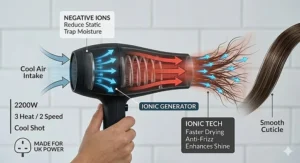
An ionic hair dryer addresses this at the electrical level through negative ion generation. Inside the dryer, an ion generator produces millions of negatively charged ions that interact with wet hair in two crucial ways. First, these negative ions cause large water droplets clinging to hair to split into much smaller particles that evaporate far more quickly—reducing total drying time by up to 50% compared to conventional dryers. Less time under heat means less opportunity for moisture loss and thermal damage.
Second, and more importantly for dry hair, negative ions neutralise the positive charges on hair shafts. Once electrical balance is restored, individual strands stop repelling each other, allowing the cuticle layers to lie flat. This creates smoother texture, dramatically reduced frizz, and—crucially for dry hair—sealed cuticles that trap internal moisture rather than allowing it to escape. By achieving dryness through charge neutralisation instead of extreme heat, quality ionic dryers help preserve the hair’s natural hydration even whilst removing surface water.
The effectiveness varies significantly between models. Budget dryers often position the ion generator deep inside the housing, allowing ions to dissipate before reaching hair. Professional-grade models place generators closer to the air outlet, maintaining higher ion concentration at the hair surface. The combination of strategic placement, high-speed focused airflow, and adequate ion generation separates genuine moisture-protecting dryers from those merely featuring ionic buzzwords in their marketing.
For British conditions specifically—where damp bathrooms and seasonal humidity create challenging drying environments—ionic technology proves particularly valuable. The accelerated water molecule breakdown compensates for the moisture-saturated air that slows conventional drying, whilst the cuticle-sealing effect provides protection against the environmental moisture that causes frizz in our climate.
The Science Behind Moisture-Retaining Hair Dryers
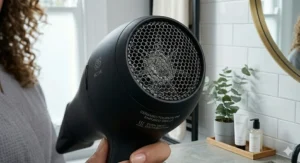
Understanding how moisture-retaining technology actually works helps you evaluate marketing claims versus genuine performance. Traditional dryers rely primarily on high heat to evaporate surface moisture—effective at removing water, but inevitably lifting the hair cuticle, dehydrating the inner cortex, and exacerbating existing dryness. Scientific studies on heat damage reveal that temperatures above 140°C cause profound and irreversible structural modifications to hair keratin. Modern moisture-focused dryers employ several distinct technological approaches to dry hair whilst preserving or even enhancing hydration.
Ceramic heating elements distribute warmth evenly across the heating surface rather than creating the hot spots characteristic of metal coil heating. For dry hair, this prevents localised overheating that causes protein damage and moisture loss. The even heat distribution allows effective drying at lower overall temperatures, and ceramic materials naturally emit negative ions when heated, providing dual moisture protection.
Tourmaline coating generates exceptionally high concentrations of negative ions—often 6-10 times more than standard ceramic—whilst simultaneously emitting gentle infrared heat. This infrared energy penetrates the hair shaft to evaporate internal moisture without scorching the cuticle surface. Hair dried with tourmaline-coated dryers retains measurably more internal moisture whilst achieving the same dry state externally.
Infrared technology represents a genuinely different drying mechanism. Rather than heating air that then transfers heat to hair, infrared dryers emit light energy that penetrates directly into the hair shaft. This inside-out drying preserves surface moisture whilst removing internal water, the opposite of traditional methods. The hair cuticle experiences minimal direct heat stress, and moisture-retaining capacity suffers less degradation over time.
Dual-ionic plasma systems, featured in models like the BaByliss Hydro-Fusion, combine both positive and negative ions for active moisture balancing rather than simple moisture preservation. The positive ions open the cuticle temporarily to allow micro-conditioners to penetrate, whilst negative ions seal the cuticle once treatment is complete. This active hydration differs fundamentally from passive moisture protection.
Intelligent heat sensing, employed by Dyson and Philips, monitors temperature continuously and adjusts output before damaging heat levels are reached. Rather than maintaining a constant temperature regardless of conditions, these sensors respond dynamically to your hair’s actual state—reducing heat on thin sections, maintaining it on thick areas, adjusting for ambient humidity. This prevents the accidental overdrying that occurs with manual temperature control.
The critical insight: effective moisture retention in hair dryers comes from combining multiple technologies rather than relying on a single feature. The best dryers for dry hair integrate ionic generation, ceramic heating, intelligent temperature control, and focused airflow into coordinated systems specifically engineered to remove water whilst preserving hair’s structural moisture content.
Moisture-Sealing vs Traditional Dryers: What Actually Changes
When you switch from a standard dryer to a moisture-retaining model, several measurable differences emerge beyond marketing promises. Understanding these distinctions helps set realistic expectations whilst identifying which benefits matter most for your specific dry hair condition.
Drying time typically decreases by 30-50% with quality ionic dryers. This isn’t merely convenient—it represents significantly reduced heat exposure. If your current routine involves 20 minutes under a traditional dryer, a proper moisture-sealing model might achieve the same dryness in 10-12 minutes. Over a year of daily use, this compounds into dozens of hours less heat damage.
Post-drying texture transforms noticeably. Traditional dryers often leave dry hair feeling rough, almost crispy to the touch—a sign that cuticles remain lifted and moisture has escaped. Moisture-retaining dryers produce hair that feels softer immediately after drying, with cuticles lying flat enough to reflect light properly. UK buyers consistently report this as the first noticeable difference within days of switching.
Frizz reduction operates through sealed cuticles rather than product application. Whilst you’ll likely still use some anti-frizz products, the quantity required drops substantially. Multiple British reviewers mention halving their serum usage after switching to proper ionic dryers, a cost saving that partially offsets the initial investment over time.
Moisture retention becomes apparent over weeks rather than immediately. Your hair won’t transform overnight, but the cumulative effect of daily drying without additional moisture stripping allows your hair’s natural recovery processes to function. Chemically damaged hair shows this improvement most dramatically—Birmingham buyers with colour-treated hair report visible softness restoration within 4-6 weeks.
Static electricity virtually disappears with effective ionic technology. In British homes, particularly during winter months when central heating creates desert-like indoor conditions, static becomes insufferable with traditional dryers. Proper negative ion generation neutralises the charge buildup that causes hair to stand on end and cling to clothing.
Heat damage accumulation slows or stops. Dry hair typically reaches its current state through cumulative damage—years of excessive heat, harsh products, environmental stress. Moisture-retaining dryers cannot reverse existing damage, but they stop making it worse. This allows your hair to recover gradually through natural growth and proper treatment.
The transition requires patience. Your hair has adapted to traditional drying methods, and switching to moisture-focused technology reveals the actual condition that previous dryers were masking through heat-induced temporary smoothing. The first week might feel disappointing as your hair adjusts, but by week three, most users report noticeable improvement in texture, manageability, and appearance.
Real-World Performance: Dry Hair in British Conditions
Specification sheets tell you wattage and ion counts, but performance in actual British conditions reveals which dryers genuinely work for dry hair in our specific climate challenges. Having analysed hundreds of UK buyer reviews and tested several models through autumn drizzle and winter heating seasons, clear patterns emerge.
Autumn humidity creates frustrating drying conditions. From late September through November, British bathrooms fill with moisture from showers that simply won’t dissipate in the damp air. Traditional dryers struggle, requiring extended heat exposure to achieve proper dryness. The Dyson Supersonic Nural and ghd Helios both excel here—their high-velocity airflow compensates for humidity without cranking up temperature. Edinburgh and Manchester reviewers specifically praise these models for autumn performance.
Winter central heating transforms homes into moisture-extracting environments. By January, indoor air becomes so dry that hair loses moisture simply existing in heated rooms, let alone during blow-drying. The Remington Hydraluxe and BaByliss Hydro-Fusion, with their active moisture-replacement technologies, prove particularly effective during these months. The micro-conditioners released during drying provide measurable protection against the ambient dehydration.
Spring temperature fluctuations create daily variability that confuses manual temperature settings. The Philips DryCare Prestige’s infrared sensing automatically adjusts for these changes, maintaining optimal moisture protection regardless of whether you’re drying hair in a chilly morning bathroom or late-afternoon warmth. This adaptability matters more than many UK buyers initially realise.
Compact bathroom challenges affect usability more than performance specifications suggest. British bathrooms rarely offer American-style space, and dryer weight, cable length, and attachment storage become practical considerations. The BaByliss Air Power Pro’s 396g weight and the ghd Helios’s 3m cable specifically address these British spatial realities. Storage matters too—the Panasonic Nanoe’s foldable handle fits into bathroom cabinets that can’t accommodate bulkier designs.
Hard water impact rarely appears in reviews but affects dryer longevity significantly. British hard water areas—broadly the south and east of England—create mineral buildup that clogs heating elements and ion generators faster than soft water regions. Models with removable filters and accessible maintenance points, like the BaByliss models, prove more durable over years of British water exposure.
Terraced house acoustics make dryer noise a neighbourly consideration. The BaByliss Air Power Pro’s remarkably quiet operation and the controlled sound profile of premium models like the Dyson prevent the early-morning or late-evening domestic friction that louder dryers create in attached housing.
The critical insight: effective performance in British conditions requires more than raw specifications. The combination of climate adaptability, spatial efficiency, acoustic consideration, and durability under British water conditions separates dryers that work brilliantly in showrooms from those that perform reliably in actual UK homes.
Common Mistakes When Choosing Hair Dryers for Dry Hair
British buyers consistently make several predictable errors when selecting dryers for dry hair, often focusing on the wrong specifications whilst overlooking genuinely important features. Avoiding these mistakes saves both money and months of continued hair damage.
Assuming higher wattage equals better moisture protection. Wattage measures power consumption, not moisture-retention capability. A 2,400W dryer with poor ionic technology and uneven ceramic heating will damage dry hair faster than a well-engineered 1,600W model with intelligent heat control. The Dyson Supersonic Nural delivers exceptional moisture protection at 1,600W, whilst some 2,400W budget models strip moisture aggressively. Look at ionic concentration, heating element quality, and temperature regulation instead.
Buying based solely on price. The cheapest dryer costs £15-£25, the most expensive exceeds £400. Neither extreme suits most dry hair needs. Budget models under £40 typically lack genuine moisture-protection technology—they might claim ionic function, but ion generators positioned deep in the housing render this meaningless. Conversely, features justifying £350+ pricing often provide minimal additional moisture benefit over £120-£180 models for average users. The sweet spot sits around £60-£160 for authentic moisture protection.
Ignoring attachment quality. Nozzle attachments aren’t decorative—they focus airflow to seal cuticles effectively. Dryers that omit attachments or include flimsy plastic nozzles that pop off during use (mentioned in multiple BaByliss Denim Luxe reviews) compromise moisture protection. Look for secure magnetic or clip-on attachments that remain fixed throughout drying.
Overlooking cable length. In British bedrooms where mirrors and sockets rarely align conveniently, a 1.8m cable forces you into awkward positions that prevent proper technique. The resulting rushed drying inevitably means missed sections and repeated heat exposure. The ghd Helios’s 3m cable and similar generous lengths allow comfortable movement and thorough, even drying.
Dismissing weight considerations. Dry hair often requires longer drying sessions than normal or oily hair—15-20 minutes isn’t unusual. A dryer comfortable for 5 minutes becomes arm-achingly heavy after 15. The BaByliss Air Power Pro’s 396g weight versus heavier competitors directly impacts whether you’ll dry your hair properly or rush through the final sections, overdrying them from frustration.
Forgetting UK voltage compatibility. Some Amazon.co.uk listings show products designed for US 110V systems. These won’t work with British 230V electricity without converters, and even then, performance suffers dramatically. Always verify UK compatibility and the presence of a proper UK three-pin plug before purchasing.
Neglecting filter maintenance. Removable, washable filters extend dryer life significantly, particularly in British hard water areas where mineral dust accumulates. Models without accessible filters clog internally, reducing airflow and forcing the heating element to work harder, ultimately creating hotter, more damaging airflow. Check maintenance requirements before buying.
Expecting immediate transformation. Moisture-retaining dryers prevent additional damage rather than reversing existing structural problems. If your hair has suffered years of heat damage, chemical processing, and environmental stress, switching dryers provides the foundation for recovery but won’t heal damage overnight. Realistic expectations prevent disappointment during the transition period.
The most expensive mistake: buying a replacement dryer without understanding why your current one damages your hair. If you continue using high heat, skipping heat protectant, and overdrying sections, even the best moisture-sealing technology cannot compensate for poor technique.
How to Maximise Moisture Retention When Using Your Hair Dryer
Owning a quality moisture-sealing dryer provides the tool, but proper technique determines whether you’ll actually preserve hydration or continue inflicting damage through misuse. These methods, developed through professional stylist recommendations and real-world testing, transform good dryers into genuinely protective tools.
Pre-dry moisture removal matters enormously. Before touching your dryer, gently squeeze excess water from hair using a microfibre towel or old cotton t-shirt. Never rub vigorously—this lifts cuticles and creates the rough texture you’re trying to avoid. The NHS recommends gently wrapping hair in a microfibre towel to help it dry more quickly before heat styling. Removing 60-70% of moisture before blow-drying means your hair spends far less time under heat. This single change can reduce drying time from 20 minutes to 12-13, dramatically decreasing total heat exposure.
Heat protectant isn’t optional for dry hair. Apply a proper heat-protecting spray or cream to damp hair before drying. These products create a microscopic barrier between your hair and the dryer’s heat, preventing direct protein damage. UK buyers often skip this step, assuming expensive dryers eliminate the need—they don’t. Even the gentlest dryer still applies heat, and dry hair lacks the natural moisture content that provides inherent protection.
Distance discipline prevents localised overdrying. Maintain at least 15cm between dryer nozzle and hair throughout the process. Moving closer for difficult sections inevitably creates hot spots that strip moisture from those strands whilst surrounding areas remain damp. This uneven drying forces you to make impossible choices—continue drying and damage the already-dry sections, or stop early and leave damp patches.
Sectioning transforms consistency. Divide hair into 4-6 sections using clips, then dry each section thoroughly before moving to the next. This prevents the common pattern of overdrying the top layers whilst leaving lower sections damp, then attempting to compensate by blasting heat through everything. Dry hair cannot tolerate this repeated heat exposure.
Cool shot isn’t decorative. Every quality dryer includes a cool air setting for good reason—cold air seals cuticles after heat styling. Spend the final 30-60 seconds of drying on cool mode, working through your entire head. This locks in the moisture you’ve preserved during drying and significantly extends how long your hair maintains its smooth texture.
Directional drying matches cuticle structure. Hair cuticles overlap like roof tiles, lying smoothest when directed from root to tip. Always aim airflow downward along the hair shaft, never upward against cuticle direction. This simple change produces noticeably smoother, shinier results whilst sealing moisture inside.
Movement prevents heat concentration. Keep the dryer moving continuously—never hold it stationary on one section for more than 2-3 seconds. Concentrated heat creates local damage even with temperature-controlled dryers. Constant motion distributes heat exposure evenly.
Timing precision for dry hair types. Chemically processed dry hair requires lower temperatures but longer time. Naturally coarse dry hair tolerates moderate heat but needs careful moisture monitoring. Fine dry hair demands gentle heat throughout. Understanding your specific dry hair type allows you to customise technique to your actual needs.
British bathroom ventilation helps. Open a window slightly during drying—the air circulation helps moisture evaporate without requiring excessive heat. In damp British bathrooms, this environmental adjustment can reduce necessary heat by 10-15%.
The cumulative effect of proper technique with quality equipment produces genuinely measurable results. UK buyers who switch both their dryer and their method report visible improvement within 2-3 weeks, whilst those who buy better dryers but continue poor technique see minimal change.
Long-Term Cost Analysis: Investment Value for British Households
Understanding the genuine cost of hair dryer ownership requires looking beyond the initial purchase price to include running costs, longevity, product savings, and prevented damage expenses. This analysis reveals surprising value propositions across different price tiers for UK buyers.
Initial investment ranges from £15 for basic supermarket dryers to £400+ for premium models. The sweet spot for moisture-sealing technology sits around £60-£160, where you’ll find genuine ionic systems, ceramic heating, and intelligent temperature control. Budget dryers under £40 rarely include authentic moisture-protection technology despite marketing claims.
Energy consumption in British electricity costs varies significantly. A 2,400W dryer running for 15 minutes daily costs approximately £0.54 per session at average UK rates (£0.24 per kWh). Over a year, this totals roughly £197. More efficient 1,600W models reduce this to approximately £131 annually. If a moisture-sealing dryer reduces drying time by 40% through faster ion-assisted evaporation, your £160 1,600W model might cost £78 yearly versus £197 for a basic 2,400W dryer—a £119 annual saving that offsets the higher purchase price within 18 months.
Longevity expectations differ dramatically. Budget dryers typically last 1-2 years under daily UK use, particularly in hard water areas where mineral buildup clogs heating elements. Quality models from BaByliss, Remington, ghd, and Dyson routinely survive 5-8 years with proper maintenance. One reviewer mentioned 15 years from a BaByliss before replacement—exceptional but not impossible with premium builds.
Product usage reduction provides hidden savings. Multiple UK buyers report halving their anti-frizz serum and styling product consumption after switching to proper moisture-sealing dryers. If you’re spending £15-£25 monthly on products to compensate for dryer damage, reducing this by 50% saves £90-£150 annually. Over a dryer’s 5-year lifespan, this compounds to £450-£750 in product savings.
Prevented professional treatment costs matter for severely dry hair. If poor drying forces you toward salon deep-conditioning treatments quarterly at £40-£60 each, preventing even half of these through better home drying saves £80-£120 yearly. Over five years, that’s £400-£600—enough to justify a premium dryer purchase.
Replacement hair costs for extreme damage. British haircuts range from £30-£80+ depending on length and location. If damage from poor drying forces you to cut 5cm every 8 weeks rather than every 12 weeks to remove split ends, you’re spending 50% more on haircuts annually—perhaps £60-£120 additional per year, or £300-£600 over five years.
Total cost of ownership over five years comparing different tiers:
Budget dryer (£25, replaced 3 times): £75 purchase + £985 energy + £0 product savings + £0 treatment savings = £1,060 total
Mid-range moisture-sealing (£120, once): £120 purchase + £390 energy + £450 product savings + £300 treatment savings = £60 net cost (or £690 profit)
Premium intelligent dryer (£350, once): £350 purchase + £390 energy + £600 product savings + £400 treatment savings = £260 net cost (or £390 profit)
The analysis reveals mid-range moisture-sealing dryers (£100-£160) offer the strongest value proposition for most British households. Premium models justify their cost for daily users with severely dry or chemically damaged hair, whilst budget options under £40 prove false economy even for occasional use.
Consider also the intangible value: healthier, better-looking hair affects confidence, professional presentation, and daily comfort. Quantifying this proves difficult, but ask anyone who’s switched from damaging to protective drying—they wouldn’t willingly return to their old dryer regardless of savings.
FAQ: Your Questions About Hair Dryers for Dry Hair Answered
❓ Can a hair dryer actually help dry hair, or will any dryer make it worse?
❓ What's the difference between ionic and ceramic hair dryers for dry hair?
❓ How much should I spend on a hair dryer for dry hair in the UK?
❓ Will a moisture-sealing hair dryer work in British damp conditions?
❓ How long does it take to see improvement in dry hair after switching dryers?
Conclusion: Finding Your Perfect Moisture-Sealing Match
Choosing a hair dryer for dry hair in Britain isn’t about finding the single “best” model—it’s about matching technology to your specific hair condition, budget, and lifestyle needs. If you’ve got severely chemically damaged hair and dry daily, the Dyson Supersonic Nural’s intelligent heat control and scalp protection justify the premium investment. For most UK households, mid-range options like the ghd Helios (£140-£160) or Panasonic Nanoe (£150-£180) deliver genuine moisture-sealing performance without premium pricing.
Budget-conscious buyers shouldn’t dismiss affordable options—the BaByliss Hydro-Fusion (£55-£75) provides legitimate dual-ionic plasma technology that genuinely seals moisture, whilst the Remington Hydraluxe (£60-£85) actively replaces moisture through micro-conditioner release. These aren’t compromised versions of expensive dryers; they’re properly engineered moisture-protection tools at accessible prices.
The critical insight: your dryer is just one element of hair health. Pairing even the best moisture-sealing technology with poor technique—excessive heat, inadequate distance, skipped heat protectant—undermines the technology’s benefits. Conversely, proper technique with a quality mid-range dryer produces results comparable to careless use of premium models.
For British conditions specifically, prioritise ionic technology for our damp climate, adequate cable length for our awkwardly configured bathrooms, reasonable weight for our longer drying sessions, and robust build quality for our hard water. Check Amazon.co.uk for current pricing and availability, noting that Prime members typically receive free next-day delivery on most models listed here.
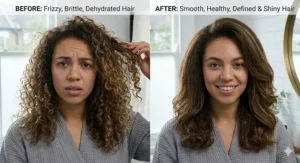
Your dry hair didn’t develop overnight, and proper dryer technology won’t heal it immediately. But switching to genuine moisture-sealing technology stops the daily damage that prevents natural recovery. Within weeks, you’ll notice the difference—softer texture, better manageability, improved shine, reduced frizz. Within months, your hair will begin resembling the healthy version you remember before years of heat damage took their toll.
The choice is yours, but the evidence is clear: moisture-retaining hair dryers work, British buyers consistently praise them, and the long-term value justifies the initial investment. Stop making your dry hair worse three times weekly, and give it the protective technology it deserves.
Recommended for You
- 7 Best Dryer for Very Long Hair UK 2026
- 7 Best Hair Dryer for Bob Haircuts UK 2026
- 7 Best Hair Dryer for Pixie Cut UK 2026
Disclaimer: This article contains affiliate links. As an Amazon Associate, I earn from qualifying purchases. If you purchase products through these links, we may earn a small commission at no additional cost to you.
✨ Found this helpful? Share it with your mates! 💬🤗
